

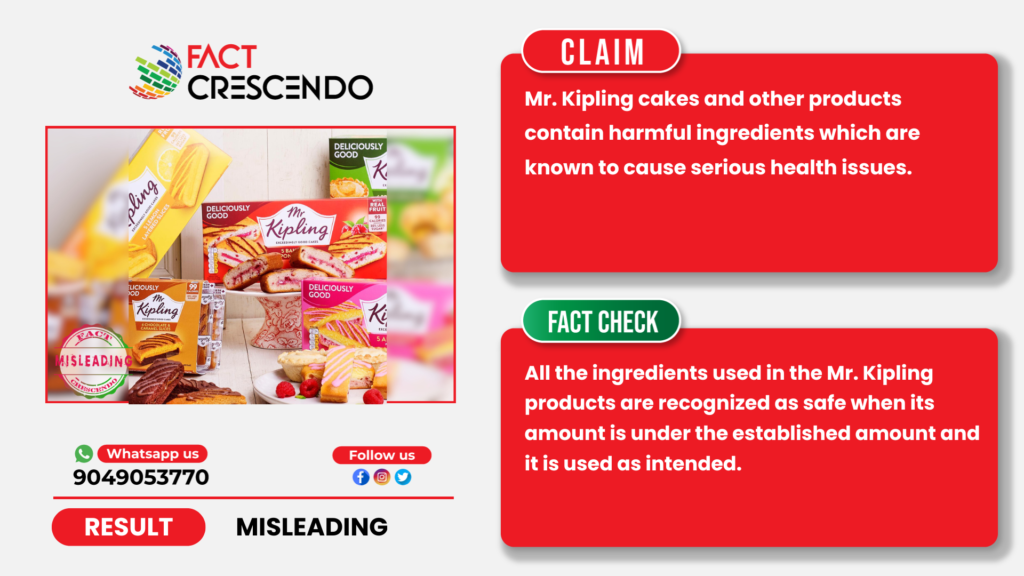
Mr. Kipling is a British cake brand owned by Premier Foods and was introduced in 1967. It is famous for its cakes, pies and other baked products. Over the years, it has gained popularity in the U.K and other countries worldwide.
But recently, some social media posts are claiming the products of Mr. Kipling contains harmful ingredients like Disodium Diphosphate, Dextrose, Polysorbate 60, Potassium Sorbate, Polyglycerol Esters of Fatty Acids etc. which are known to cause health issues in humans.
However, Fact Crescendo found the claim to be misleading. Mr. Kipling uses all the approved ingredients which are permitted by the food safety regulatory bodies. These ingredients are considered safe when used under the established limits.
Fact Check-
We checked the facts about the safety of each of the ingredients mentioned in the viral video which you can read below.
Disodium Diphosphate: Disodium Diphosphate is a food additive used as an emulsifier for mixing ingredients and to retain moisture in processed foods like seafood, meats and bakery items.
The European Food Safety Authority (EFSA), the U.S. FDA and the Joint FAO/WHO Expert Committee on Food Additives (JECFA) have evaluated the safety of this additive and found it to be generally safe to use in foods at permitted levels. It has low toxicity and is not found to be genotoxic or carcinogenic. The European Food Safety Authority (EFSA) has established an Acceptable Daily Intake (ADI) value of 40 mg per kilogram of body weight per day for all the phosphate additives. The additive is considered safe when the amount remains under the ADI value.
Polyglycerol Esters of Fatty Acids: Polyglycerol esters of fatty acids (E 475) are used in many foods to help mix water and fat to give the product a smooth and stable texture. The EFSA panel had re-evaluated the safety of this ingredient and found no evidence that it causes harm at the amounts people usually eat in foods, and it is considered safe when used as allowed in food products.
The FDA has approved the use of this ingredient as an emulsifier in foods but under certain conditions. This ingredient must be prepared from corn oil, cottonseed oil, lard, palm oil from fruit, peanut oil, safflower oil, sesame oil, soybean oil etc. and must be used in amounts not greater than that required to produce the intended physical or technical effect
Polysorbate 60: According to the Code of Federal Regulation’s report, Polysorbate 60 is made by combining stearic and palmitic acids with sorbitol and polyoxyethylene. It helps mix ingredients like oil and water and is used in various food products. It is approved for safe use in certain foods. The regulatory body has set limits on the use of Polysorbate 60 in different foods. For example, in cakes and cake mixes, it cannot be more than 0.46% of the dry weight. In icings and fillings, the total amount should not exceed 1% when mixed with similar emulsifiers. These rules ensure Polysorbate 60 is used safely in food.
FDA has also approved the use of Polysorbate 60 as food additive and categorised it as Generally Recognized as Safe (GRAS).
Potassium Sorbate: Potassium sorbate is a chemical food additive which is used as a preservative in foods. It prevents the growth of molds, fungi and yeast. It can be found in many food products like cheese, chewing gums, processed meat, citrus fruits, wine and in personal care products etc.
According to a report, regulatory agencies such as the FDA, the United Nations Food and Agriculture Organization, and the European Food Safety Authority (EFSA) have determined that potassium sorbate is “generally regarded as safe,” (GRAS). When one eats potassium sorbate as a food additive, it passes through the system harmlessly as water and carbon dioxide. It does not accumulate in the body.
The European Food Safety Authority (EFSA) reviewed the safety of sorbic acid and its salts like potassium sorbate and calcium sorbate, which are commonly used as food preservatives in the EU. These additives were already approved under EU law and an acceptable daily intake (ADI) of 25 mg per kg of body weight per day was set. Studies showed that potassium sorbate is easily absorbed by the body and mostly broken down into carbon dioxide after digestion. Animal studies did not show harmful effects even at very high doses. No evidence suggesting that potassium sorbate damages DNA was found.
Dextrose: Dextrose is a type of sugar that usually comes from corn or wheat. It can be quickly used as a source of energy by the human body. It is often used in foods as an artificial sweetener or a preservative. It is generally found in sauces, chips, canned foods, pickles, jams etc. As Dextrose has a high glycemic index, it can increase blood sugar quickly and lead to diabetes. Weight gain, heart disease etc.
However, the FDA considers Dextrose as safe when it is used within the set limits. The FDA had allowed the use of dextrose not only as a sweetener but also as an anticaking agent, flavor enhancer, coloring adjunct etc.
Food Safety and Standards Authority of India (FSSAI) had also approved the use of dextrose in many consumable products like dairy whitener, ice cream, kulfi, foods for infants, synthetic syrup etc.
Conclusion:
Fact Crescendo found the claim to be misleading. All the ingredients used in the Mr. Kipling products are recognized as safe when its amount is under the established amount and it is used as intended.
Title:Social media posts claiming harmful ingredients in Mr. Kipling products are misleading.
Fact Check By: Siddharth SahuResult: Misleading
