

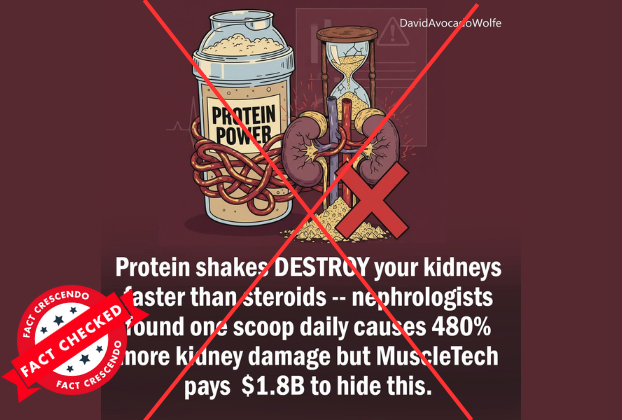
Social media posts circulating on platforms claim that protein shakes destroy kidneys faster than anabolic steroids, that nephrologists found one scoop a day causes “480% more kidney damage,” and that MuscleTech allegedly paid $1.8 billion to suppress this information. Upon our investigation, we found that the claim is false based on available evidence.
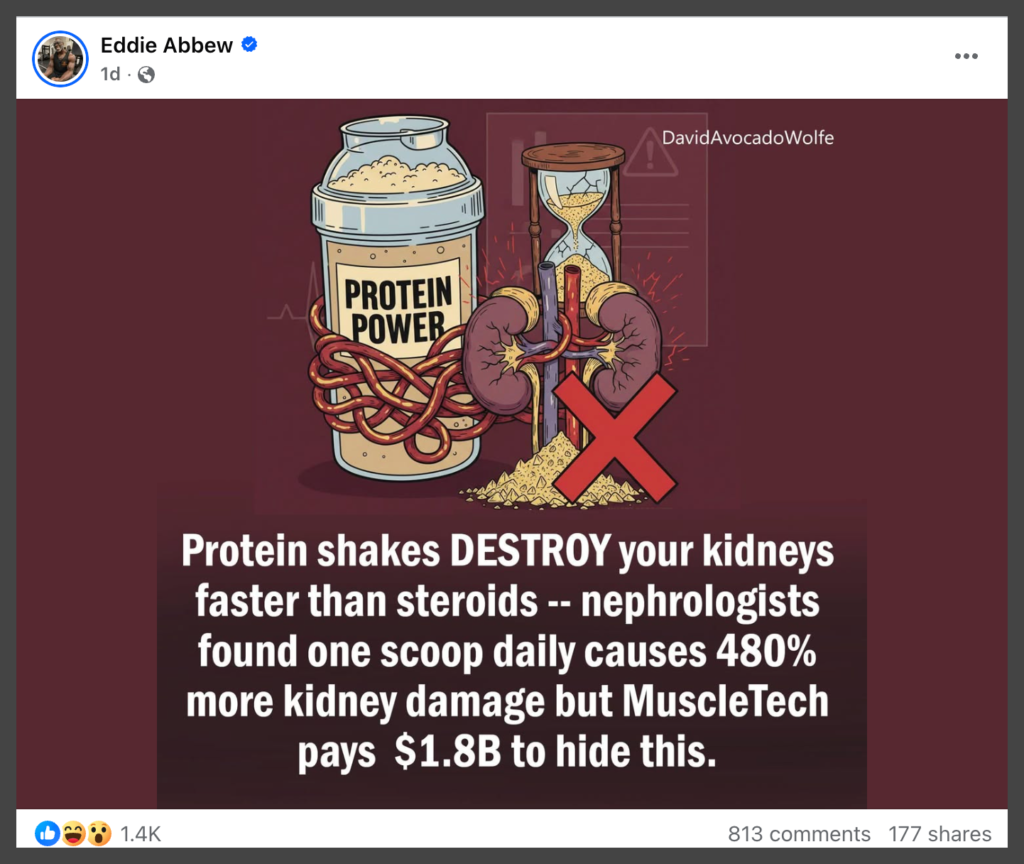
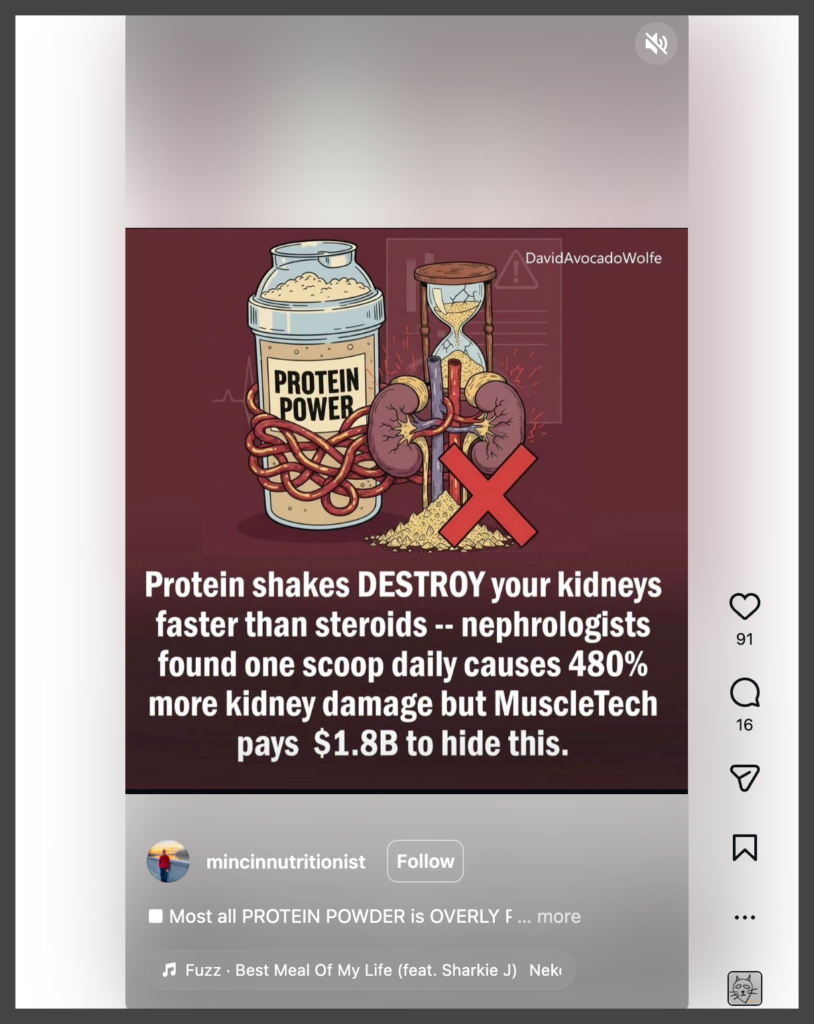
Social Media Posts
The posts typically combine two assertions: the first claims that “one scoop/day” of protein powder causes a dramatic increase in “kidney damage,” and the second claims that MuscleTech paid $1.8 billion to hide the alleged findings.
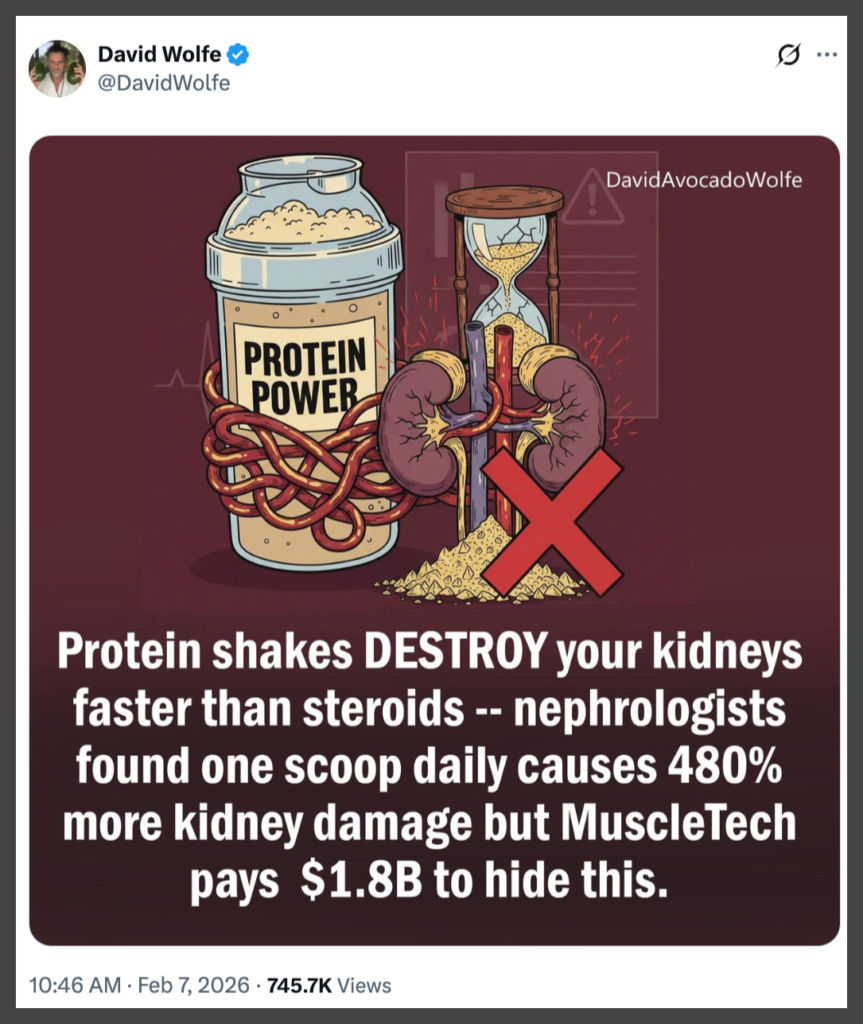
The claim has also become viral on X.
Fact Check
What nephrology guidelines actually say about protein and kidneys
Major kidney guidelines focus on people who already have chronic kidney disease (CKD), because protein intake can influence how the disease progresses and how patients feel. For adults with CKD stages G3-G5 (moderate to severe kidney disease), KDIGO recommends keeping protein intake around 0.8 g/kg/day, roughly the general population recommendation, and advises avoiding high protein intake (more than 1.3 g/kg/day) in adults with CKD who are at risk of their disease worsening. Importantly, this is guidance for managing existing kidney disease, not evidence that a typical protein shake causes kidney damage in healthy individuals.
The National Kidney Foundation similarly emphasizes that protein targets should be individualized in CKD and often require guidance from renal dietitians. This supports the standard clinical position: protein management matters for CKD, but that does not translate into “one scoop/day causes massive kidney damage” in the general population.
What research shows in people without diagnosed kidney disease
In generally healthy adults, evidence syntheses commonly report that higher protein intake can increase measured filtration (an adaptive “hyperfiltration” response) without showing clear harmful shifts in standard blood markers over typical study durations. A systematic review of renal outcomes in healthy individuals consuming protein above the RDA reports that many trials observe higher GFR while remaining within normal function ranges, with limited evidence of harm in the study windows.
A meta-analysis of randomized controlled trials comparing higher- vs lower-protein diets found changes in kidney function did not differ between higher- and lower-protein groups when comparing changes over time, even if post-intervention levels differed. This is incompatible with a claim that one scoop/day causes a several-fold increase in “kidney damage.”
The “one scoop/day” wording likely comes from a study, but it was not about “kidney damage”
The unusually specific phrase (“one scoop/day”) appears in a short, controlled study in healthy volunteers that compared one scoop/day of whey protein vs albumin for 3 days, measuring urinary kidney-stone risk factors, not kidney damage or CKD progression. Short-term urinary chemistry changes are distinct from long-term kidney damage, and the study’s endpoints differ from those described in the viral claim.
Separately, longer studies in resistance-trained populations are often cited in this debate. A one-year crossover study of resistance-trained men consuming very high protein intakes reported no harmful effects on measured markers of liver and kidney function in that cohort (with the usual caveats about sample size and population).
The “protein shakes are worse than steroids” comparison is not evidence-based
Anabolic-androgenic steroid (AAS) abuse is directly linked to serious kidney disease in multiple human studies. In bodybuilders with long-term steroid use, doctors have documented specific kidney damage patterns, including focal segmental glomerulosclerosis (FSGS), a condition where the kidney’s filtering units become scarred, and significant proteinuria (excess protein in the urine, a key sign of kidney dysfunction). (Source)
Reviews and case reports also describe plausible mechanisms and clinical patterns of steroid-associated kidney injury (acute and chronic), often involving multiple risk factors seen in bodybuilding contexts. This body of evidence makes it implausible to claim, without extraordinary proof, that typical protein supplementation is “faster” or “worse” for kidneys than steroids.
Experts Comment
Dr. Arun L. Naik from AIIMS clarified that protein powder does not harm kidneys in healthy adults and that the myth of protein damage could discourage adequate protein intake. Similarly, gastroenterologist Dr. Anshuman Kaushal states that whey protein is generally safe for healthy individuals, with most issues arising from extremely high intake or poor-quality products rather than protein itself.
Professor Stu Phillips reinforces this view, noting that higher protein intake may increase kidney function measures, but there is no evidence that it causes kidney disease in healthy people. Registered dietitian Kathy Wong adds that protein needs vary by age, activity, and health status, and healthy kidneys can generally handle normal protein supplementation without harm. This consensus is further supported by a review in Nutrition & Metabolism, which finds no significant evidence linking high protein intake to chronic kidney damage in individuals with normal renal function.
The MuscleTech Context: what is documented vs what is not
MuscleTech is a sports nutrition brand associated with Iovate Health Sciences, and there is documented corporate history around Iovate’s ownership and business activity. For example, Reuters reported on China’s Xiwang being in talks to acquire Iovate (the owner of MuscleTech) in 2016.
Public records do not show evidence that MuscleTech paid $1.8 billion related to kidney-damage findings. A payment of that size would ordinarily be documented in court filings, regulatory announcements, or financial disclosures.
What is documented is that Iovate has faced enforcement and legal action in other areas, involving millions of dollars, not billions. For example, the U.S. Federal Trade Commission announced a settlement requiring Iovate entities to pay $5.5 million for allegedly making false advertising claims about certain supplements and to stop making misleading claims going forward.
There are also publicly documented class action settlements related to disputes over how protein products were marketed and tested (commonly called “protein spiking” allegations, where manufacturers were accused of using cheaper ingredients to artificially inflate protein content on labels). These settlements involved payouts in the millions of dollars, not billions.
None of these documented actions relate to allegations of suppressed nephrology findings regarding “one scoop/day causes 480% more kidney damage,” nor do they involve a $1.8B payment. Additionally, kidney damage is not clinically measured or reported as a percentage increase in this manner, making the “480%” figure medically meaningless without a defined baseline.
Why the claim fails basic verification standards
A claim as specific and extreme as “480% more kidney damage” would normally be supported by identifiable and reproducible details: a study title, journal, DOI, cohort description, endpoints (eGFR decline, albuminuria, incident CKD), and a clear timescale. The circulating posts do not provide these, and the closest traceable “one scoop/day” study concerns stone risk factors, not kidney injury.
Meanwhile, the “MuscleTech paid $1.8B” allegation includes no verifiable legal documentation (no case name, court, docket number, regulator, settlement administrator, or SEC disclosure). The absence of such documentation makes it difficult to verify or substantiate this specific claim.
Conclusion
The viral claim that protein shakes “destroy your kidneys faster than steroids” and that MuscleTech paid $1.8 billion to suppress evidence is false. Current nephrology guidelines and peer-reviewed research do not support the assertion that typical protein supplementation causes significant kidney damage in healthy individuals, and there is no credible public record of any such corporate payment.

Title:No Evidence That Protein Shakes Cause Severe Kidney Damage or That MuscleTech Paid $1.8B to Hide Findings
Fact Check By: Pranpreeya PResult: False
