

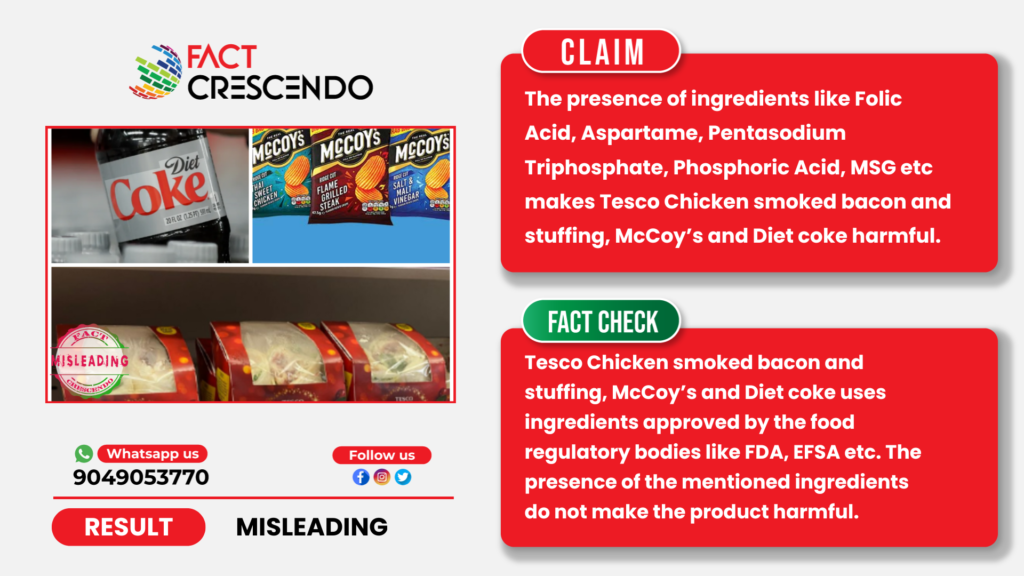
With the increase in awareness among consumers about the safety of their loved brands and products, many claims trying to defame the brands are also on the rise. One such claim on social media suggests that ingredients used in Tesco Chicken, McCoy’s and Diet Coke use ingredients that are not safe for human consumption.
The claim states that the use of folic acid, sodium nitrite, Pentasodium triphosphate, MSG, aspartame and phosphoric acid used in Tesco Chicken smoked bacon and stuffing, McCoy’s and Diet coke leads to serious health issues like cancer, immune system disruption, kidney problems etc.
However, Fact Crescendo found the claim to be misleading. Food regulatory bodies have clarified that the ingredients mentioned in the viral post are approved to be used in foods within the established limits.
Fact Check-
Let’s check the facts of the ingredients mentioned in the viral video.
Folic Acid: Folate or Folic acid is a type of Vitamin B, found in leafy greens and helps in keeping DNA stable and supports cell functions. A lack of folate has been linked to various cancers, including colon, breast, ovarian, pancreatic, brain, lung, and cervical cancer.
Several studies have looked at whether folic acid (FA) supplements affect cancer risk. Researchers analyzed data from multiple clinical trials where people took FA supplements for various health reasons, with doses ranging from 0.4 to 40 mg per day. Most studies show that folic acid (FA) supplements do not significantly increase cancer risk. One analysis suggested a small (7%) increase, but the evidence wasn’t strong. No major links were found between FA and common cancers, though one study did show a 24% higher risk of prostate cancer but another study found a 53% lower risk of skin cancer.
According to Lancet, a study over 5.2 years found that taking folic acid significantly increased blood folate levels but did not significantly affect overall cancer risk. There was no clear link between taking folic acid for a longer time and a higher cancer risk. Studies also found that folic acid did not significantly affect the risk of colon, prostate, lung, or breast cancer.
The Centers for Disease Control and Prevention (CDC) states that taking 400 micrograms (mcg) of folic acid daily is safe and effective, especially for women who can become pregnant, as it helps prevent serious birth defects. Intake of this value does not cause any harm. Taking up to 1 mg of folic acid daily is generally safe for most people, but higher doses may cause side effects like stomach issues, nausea, skin reactions, or even seizures.
Sodium Nitrite: Sodium Nitrite is majorly used in the meat industry as it restricts the growth of certain bacterias and also helps in preserving the color and flavor.
According to the National Institute of Health, sodium nitrite can react with meats to form nitroso compounds during high-temperature cooking or while processing the meat. Many of these nitrosamines are classified as potentially carcinogenic. The International Agency for Research on Cancer (IARC) has stated that nitrite under conditions that lead to the formation of nitroso compounds is considered carcinogenic to humans.
Exposure to nitrites at high levels converts hemoglobin to methemoglobin, reducing the blood’s ability to carry oxygen and potentially leading to hypoxia, particularly in infants. Excessive nitrite intake may also interfere with iodine metabolism.
However, sodium nitrite is considered safe when used at low levels in food products. Low levels of nitrites in food maintains a balance between its preservative property and the risk of harmful by-products.
The FDA had also approved the use of sodium nitrite as antimicrobial agent, antioxidant, color or coloring adjunct, flavor enhancer etc.
Pentasodium Triphosphate: Pentasodium Triphosphate, also known as sodium tripolyphosphate (STPP) helps in retaining moisture, improves texture, helps emulsify ingredients, and stabilizes or thickens products. It is commonly used in processed meats, seafood, poultry, dairy products.
The FDA considers sodium tripolyphosphate to be “Generally Recognized As Safe” (GRAS) when used in accordance with good manufacturing practices and within established limits. In modified starch foods, the upper limit of the ingredient has been fixed to 0.4%, calculated as phosphorus.
MSG: MSG consists of sodium and L-glutamate, which enhance the umami flavor without altering salt perception. According to regulatory authorities like the U.S. FDA, MSG is classified as “Generally Recognized as Safe” (GRAS). The FDA recommends keeping MSG intake below 0.5 grams per meal, as larger amounts (over 3 grams) may cause mild, transient symptoms in some individuals, such as headaches or flushing. However, most foods with added MSG contain less than 0.5 grams per serving, making overconsumption unlikely. Similarly, the European Food Safety Authority (EFSA) and the World Health Organization (WHO) affirm MSG’s safety within regulated limits. FDA recommendations can be referred here, and European Union guidance can be found here.
Aspartame: Aspartame is a low-calorie sweetener which tastes sweet but does not contain any natural sugars and its calorie level is much less than sugar. It is 200 times sweeter than sugar that is why it is used in very less quantity. It is an artificial substance and made of two naturally occurring amino acids called aspartic acid and phenylalanine.These two amino acids are found in various foods and in the human body as well.
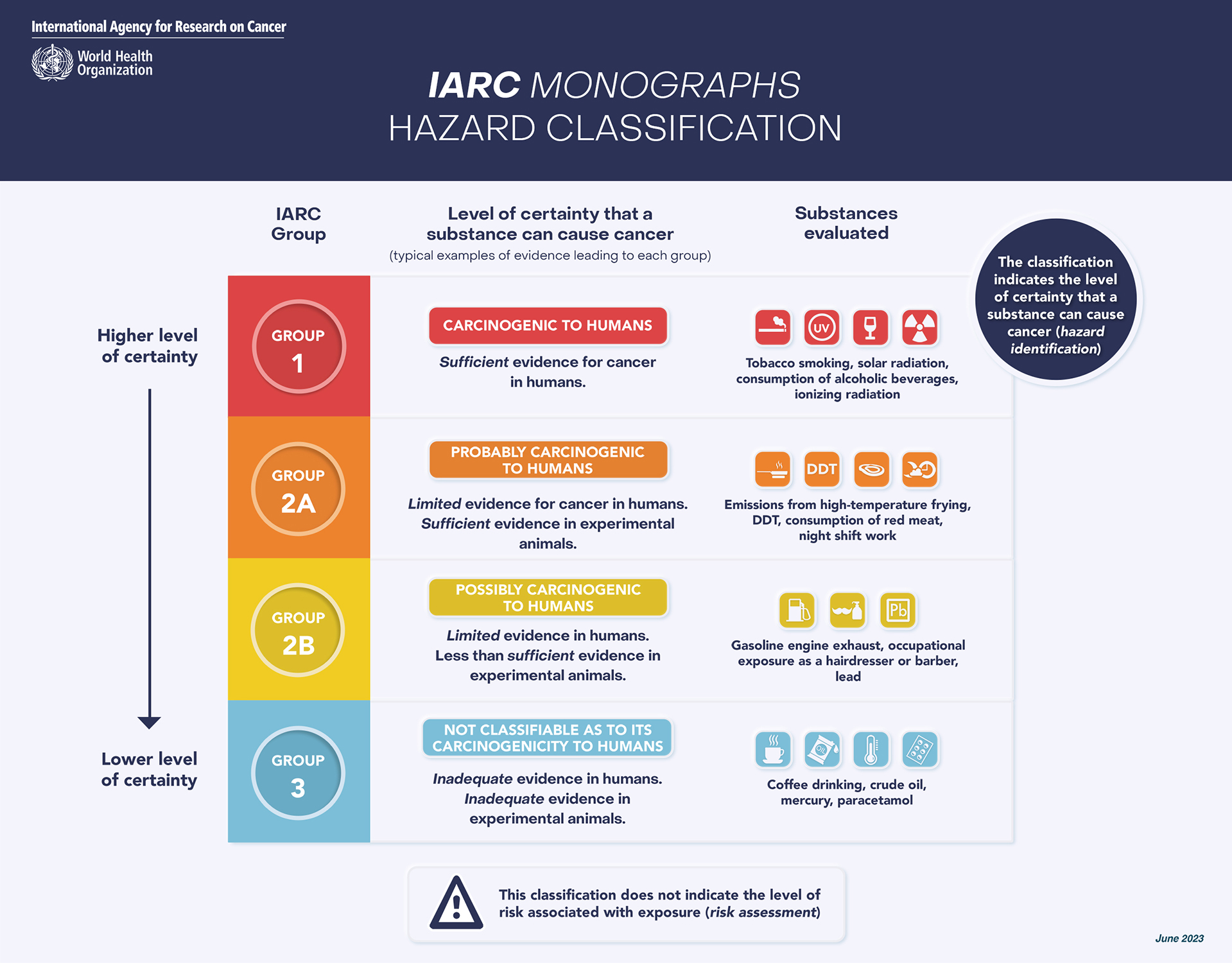
According to the World Health Organization (WHO), the International Agency for Research on Cancer (IARC) conducted a study and classified Aspartame as possibly carcinogenic to humans (Group 2B) based on limited evidence for cancer in humans. Group 2B category means possibly carcinogenic to humans. Gasoline engine exhaust, occupational exposure as hair dresser or barber etc falls under this classification.
JECFA had also concluded that there was no convincing evidence from experimental animal or human data that aspartame has adverse effects after ingestion. JECFA confirmed that aspartame is safe to consume within the daily limit of 0–40 mg per kilogram of body weight. That means, a 70 kg adult would need to drink more than 9–14 cans of diet soda in a day to go over the limit, as long as they don’t get aspartame from other foods.
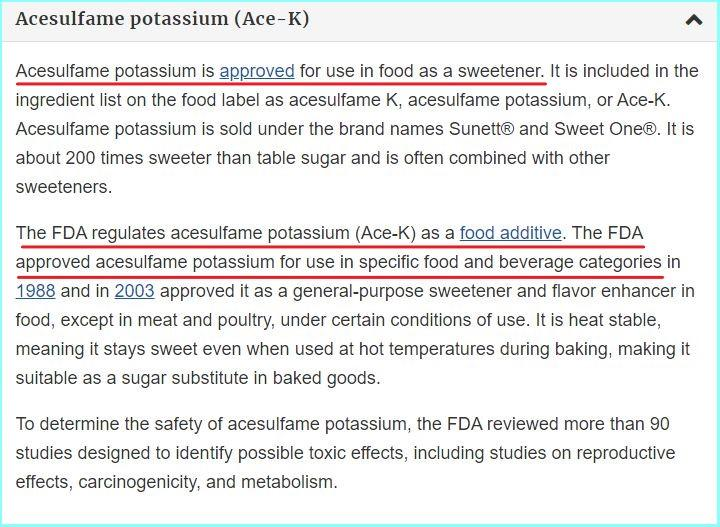
Acesulfame K: Acesulfame potassium, also known as Ace-K or E950 has been approved by FDA for use in food as a sweetener. The FDA approved acesulfame potassium (Ace-K) as a food additive in 1988 for certain foods and beverages, and in 2003, it was approved as a general sweetener and flavor enhancer. To ensure its safety, the FDA reviewed over 90 studies that looked at potential toxic effects, including its impact on reproduction, cancer risk, and metabolism.
According to another report, the FDA and National Cancer Institute (NCI) had confirmed that Ace-K is safe and that there is enough evidence to say that it does not cause cancer. In 2005, the National Toxicology Program conducted a large animal study where they gave mice acesulfame potassium, making up 3% of their diet, for over 40 weeks. This is roughly equal to a person consuming more than 1,000 cans of soft drinks daily. The study found no evidence of an increased risk of cancer in the mice.
Caramel E150d: The scientific panel reviewed the safety of four types of caramel colours used in foods and found that they are generally safe when consumed within set limits. These colours are made by heating sugars in different ways. Based on animal studies, the panel set a combined safe intake level for all caramel colours except for E150c. Due to possible effects on the immune system, a lower limit of E150c was set by the panel. The panel clarified that key harmful substances found in caramel colours are not currently a major concern.
What is 4-MEI found in E150d: 4-methylimidazole (4-MEI) is a chemical compound that forms as a byproduct at low levels in some foods and beverages during the normal cooking process. 4-MEI may form when coffee beans are roasted and when meats are roasted or grilled. It also forms while preparing Class III and Class IV caramel color.
According to the FDA, there are no immediate or short-term health risks presented by 4-MEI at the levels expected in food. In 2007, the National Toxicology Program (NTP) issued reports summarizing the results of toxicological testing conducted on 4-MEI in rats and mice. A 2-year study in rats was inconclusive regarding carcinogenicity, but a 2-year mouse study showed an increased incidence of certain lung tumors. These NTP studies were conducted in rodents at levels of 4-MEI that far exceed current estimates of human exposure to 4-MEI from the consumption of food with or without the addition of Class III or Class IV caramel coloring.
In March 2020, a study tested whether 4-MEI affects reproduction and development in rats and found some effects at very high doses. However, these doses were much higher than what people normally consume through food.
Phosphoric acid: Phosphoric acid is a chemical often added to foods and drinks, including soft drinks, to give them a tangy taste and help control acidity, flavor, and shelf life. The U.S. Food and Drug Administration (FDA) approved its use in foods as a flavor enhancer, pH control agent, and antimicrobial agent. It is considered safe when used as mentioned in the current regulations. Although, the concentrated form of Phosphoric acid can be irritating or harmful.
EFSA re-evaluated phosphoric acid and found no evidence of it to cause cancer or genetic damage. Phosphoric acid has low toxicity and has been already approved as a food additive in the European Union. The organization had established an acceptable daily intake (ADI) of 40 mg of phosphorus per kilogram of body weight per day. However, EFSA also pointed out that estimated dietary intake could exceed this ADI in infants and children.
Conclusion:
Fact Crescendo found the claim to be misleading. Tesco Chicken smoked bacon and stuffing, McCoy’s and Diet coke uses ingredients approved by the food regulatory bodies like FDA, EFSA etc. The presence of the mentioned ingredients do not make the product harmful.
Title:Misleading claims related to ingredients used in Tesco Chicken, McCoy’s and Diet Coke is going viral on social media.
Fact Check By: Siddharth SahuResult: Misleading
