

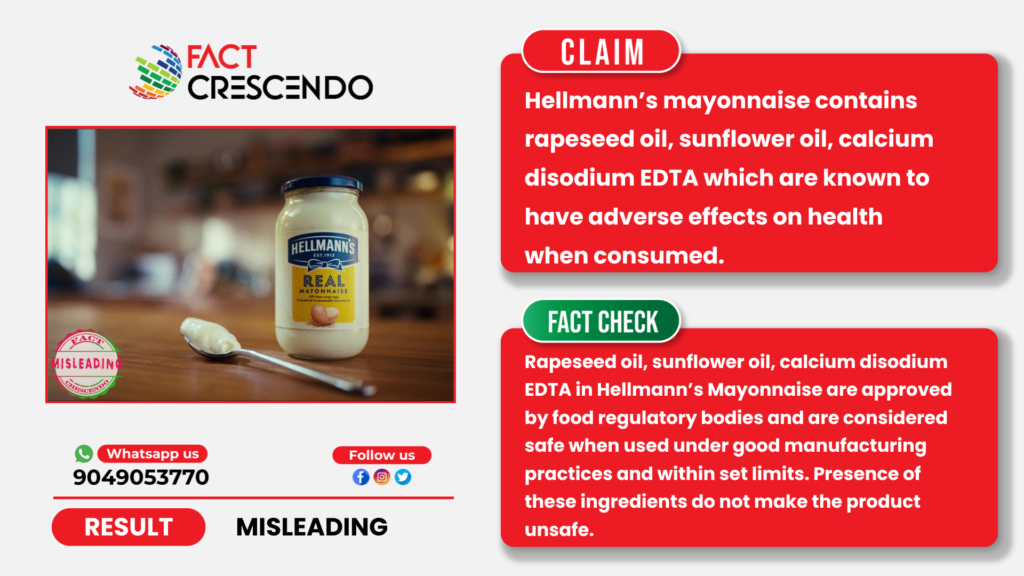
Hellmann’s mayonnaise originated in 1913 by Richard Hellmann who began selling his homemade mayonnaise in New York City. After gaining its popularity, Hellmann started producing it commercially. Over the decades, Hellmann’s has evolved into a globally recognized brand.
Recent claims on social media suggest that Hellmann’s mayonnaise contains ingredients like rapeseed oil, sunflower oil, calcium disodium EDTA which are harmful and damages DNA.
However, Fact Crescendo found the claim to be misleading. All the mentioned ingredients in the products are approved by food safety regulatory bodies and are safe when consumed within prescribed limits.
What’s the claim?
The claim described Hellmann’s mayonnaise as a slow death in a bottle. It further states that it contains 78% rapeseed oil (an industrial seed oil) which is almost the whole bottle. It blocks the arteries and disrupts hormones. The product also contains sunflower oil which is high in Omega-6 which breaks in the body to form harmful aldehydes. This causes cancer and damages DNA. The calcium sodium EDTA damages the kidney and liver.
Fact Check-
Let’s check the safety and facts of the mentioned ingredients.
Rapeseed Oil: Rapeseed Oil is a vegetable oil extracted from rapeseed. The seeds are extracted and go through a process of drying and purification. The oil is then extracted by pressing the seeds, resulting in crude oil, which then undergoes a refining process.
It is true that Rapeseed oil is also an industrial oil. But in many regions of the world, rapeseed oil is also known as Canola oil. After the purification process Rapeseed oil becomes Canola oil but many places labelled canola oil as rapeseed oil as well. So, it will not be appropriate to call rapeseed oil solely an industrial oil.
Canola oil is healthy because it is low in unhealthy saturated fats (only 4%) and high in good fats like oleic acid (55%) and other polyunsaturated fats. Unlike older rapeseed oils, canola oil has very low levels of erucic acid, which was once thought to be harmful. Because of its healthy fat profile, canola oil fits well with dietary guidelines aimed at reducing heart disease risk. It’s the most commonly used oil in Canada and is considered safe to eat by the U.S. FDA.
According to the Canola Council Canada’s website, Canola oil is good for the heart and may help lower the risk of heart disease when used instead of fats high in saturated fat. The U.S. FDA allows the use of canola oil. There are both genetically modified (GM) and non-GM types of canola. No matter if the canola is genetically modified or not, the oil is exactly the same because all proteins are removed during processing. Canola oil is considered safe to eat, even for babies in infant formula.
The Food and Drugs Administration (FDA) listed rapeseed oil and its defined forms as Generally Recognized As Safe (GRAS) when used according to the standards set by the regulation. The use level of the ingredient is limited by good manufacturing practice (GMP) to the minimum amount required to produce the intended effect.
Sunflower Oil: EFSA explained that sunflower oil is generally safe for people, animals, and the environment when used properly. It is also used as a fungicide on vegetables. It is not toxic, does not cause health problems, and breaks down naturally without leaving harmful residues. EFSA even agreed that there are no major risks to consumers, workers, or the environment when exposed to it. However, some areas need more data for further study, but overall the oil is considered safe and suitable for use for agricultural purposes as well.
The Food and Drug Administration (FDA) includes sunflower seed oil and its triglycerides or fatty acids on its list of indirect food additives. These ingredients can be used in special coatings that might touch food by accident. The CIR Panel studied sunflower seed oil, hydrogenated sunflower seed oil, and sunflower seed acid and found these to be safe when used in cosmetics and personal care products as well.
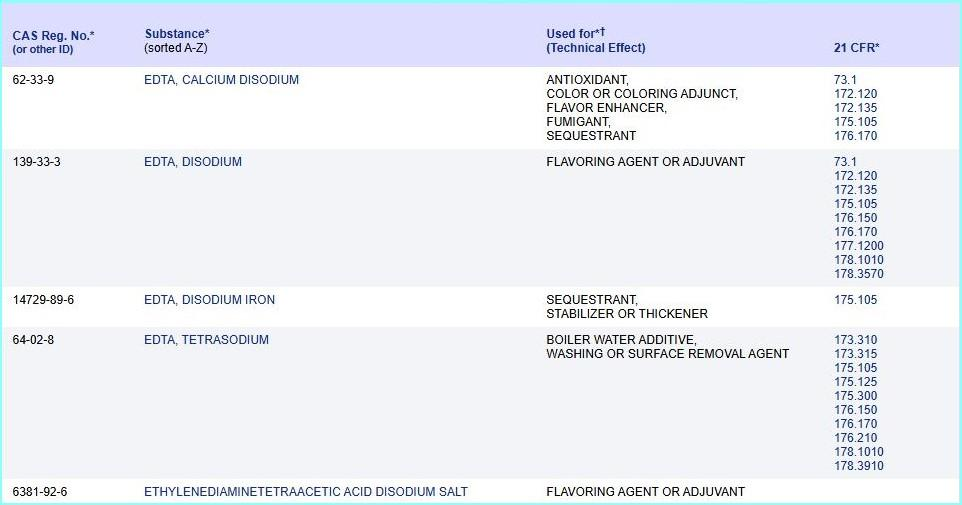
Calcium Disodium EDTA: Ethylenediaminetetraacetic acid (EDTA) and its derivatives, such as calcium disodium EDTA and disodium EDTA, are approved as food additives by the U.S. Food and Drug Administration (FDA). These compounds are utilized for their ability to bind metals, which helps preserve food quality and extend shelf life. The limitation set by the food regulatory agencies for EDTA is 75 parts per million in salad dressing, mayonnaise, sauces etc.
The FDA had approved the use of EDTA and its forms as food additives and categorised it Generally Recognized as Safe. Below you can see different ETDA and its uses.
Conclusion:
Fact Crescendo found the viral claim to be misleading. Rapeseed oil, sunflower oil, calcium disodium EDTA in Hellmann’s Mayonnaise are approved by food regulatory bodies and are considered safe when used under good manufacturing practices and within set limits.
Title:Hellmann’s Mayonnaise contains approved ingredients. The claim is based on partial information.
Fact Check By: Siddharth SahuResult: Misleading
