

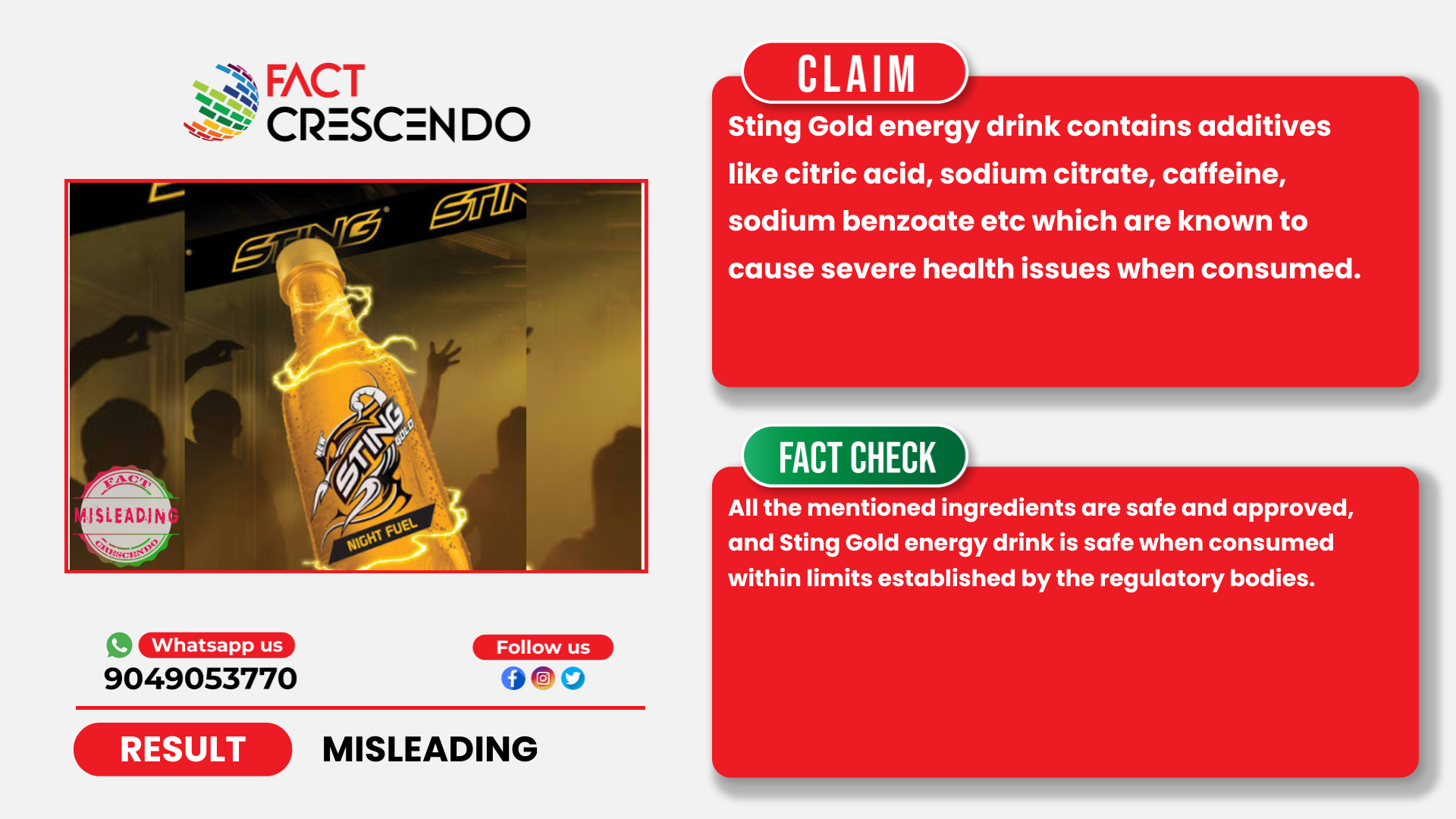
Social media posts have claimed that Sting Gold Energy Drink contains numerous synthetic and harmful additives which gave the product a safety score of 2 out of 10. The claim suggests that the presence of these ingredients are harmful when consumed. Some of the major ingredients listed are citric acid, sodium citrate, caffeine, sodium benzoate etc.
Fact Crescendo found the claim to be misleading. After fact check, it was found that all the mentioned ingredients are safe and approved and Sting Gold energy drink is safe when consumed within limits established by the regulatory bodies.
Fact Check-
Let’s check the facts of the ingredients mentioned in the video.
Citric Acid: Citric acid (C₆H₈O₇) is a naturally occurring compound found in plants and animals. It appears as a colorless crystal or white powder. It can be obtained from natural sources like lemon or pineapple juice, or produced through fermentation using specific fungi such as Candida or Aspergillus niger. The citric acid used in food must meet the quality and purity standards set by the Food Chemicals Codex. It is approved for use in food without any restrictions if prepared under good manufacturing practices guidelines.
Citric Acid (E330) is also listed under approved additives by Food Safety Standards in the UK.
Sodium Citrate: Sodium citrate is commonly used as an acidity regulator, buffer, emulsifier, and preservative in foods and beverages. The National Institute of Health stated that this additive has been evaluated by the food safety authorities and is considered safe. After consumption, sodium citrate breaks down into citrate which is well metabolised and does not accumulate in the body as a toxic substance. However, very large amounts of sodium citrate can cause temporary gastrointestinal discomfort or affect electrolyte balance in people with severe kidney disorder. But, the amount of this additive in food and beverages is quite low and falls under the safe zone.
Caffeine: Caffeine is a naturally occurring compound found in plants like coffee, tea, and cocoa, and is commonly added to foods and beverages including energy drinks. It is rapidly absorbed in the human body and can increase alertness but may also cause short-term effects such as anxiety and sleep disruption, especially in high doses.
EFSA conducted a risk assessment of Caffeine use during physical activity and in combination with alcohol or energy drink ingredients. The panel concluded that single doses up to 200 mg, and daily intakes up to 400 mg, are safe for healthy adults. For pregnant and lactating women, up to 200 mg per day is considered safe. For children and adolescents, a daily intake of up to 3 mg per kilogram of body weight is acceptable.
EFSA also found no safety concerns when caffeine is consumed with common energy drink ingredients or moderate amounts of alcohol.
Sodium Benzoate: Sodium benzoate is a chemical made by mixing benzoic acid with substances like baking soda or sodium hydroxide. It does not occur naturally. According to the Code of Federal Regulations, it is generally safe when used according to good manufacturing practices, with a maximum limit of 0.1% in food. The FDA has not confirmed its safety for other uses.
The European Food Safety Authority (EFSA) evaluated a study from Southampton University that suggested certain food additives, including artificial colors and sodium benzoate, might be linked to hyperactivity in children. EFSA reviewed the study and found that while some children may be sensitive to these additives, the overall evidence was not strong enough to confirm a direct link to hyperactivity. Based on this, EFSA did not change the safety limits for these additives but recommended further research.
Potassium Sorbate: Potassium sorbate is a chemical food additive which is used as a preservative in foods. It prevents the growth of molds, fungi and yeast. It can be found in many food products like cheese, chewing gums, processed meat, citrus fruits, wine and in personal care products etc.
According to a report, regulatory agencies such as the FDA, the United Nations Food and Agriculture Organization, and the European Food Safety Authority (EFSA) have determined that potassium sorbate is “generally regarded as safe,” (GRAS). When one eats potassium sorbate as a food additive, it passes through the system harmlessly as water and carbon dioxide. It does not accumulate in the body.
The European Food Safety Authority (EFSA) reviewed the safety of sorbic acid and its salts like potassium sorbate and calcium sorbate, which are commonly used as food preservatives in the EU. These additives were already approved under EU law and an acceptable daily intake (ADI) of 25 mg per kg of body weight per day was set. Studies showed that potassium sorbate is easily absorbed by the body and mostly broken down into carbon dioxide after digestion. Animal studies did not show harmful effects even at very high doses. No evidence suggesting that potassium sorbate damages DNA was found.
Sucralose: Sucralose, also known as E 955, is used as a sweetener. Some studies have shown that sucralose can affect the human gut by reducing good bacteria by half. Research on animals also suggests that it may cause inflammation in the body. Too much inflammation over time can lead to health problems like obesity and diabetes.
However, sucralose is approved for use in food as a sweetener. It is sold under the brand name Splenda. The the FDA had approved sucralose for use in 15 food categories in 1998 and for use as a general-purpose sweetener for foods in 1999, under certain conditions of use. To determine the safety of sucralose, the FDA reviewed more than 110 studies designed to identify possible toxic effects, including studies on the reproductive and nervous systems, carcinogenicity, and metabolism. The FDA also reviewed human clinical trials to address metabolism and effects on patients with diabetes.
Acesulfame Potassium: Acesulfame potassium, also known as Ace-K or E950 has been approved by FDA for use in food as a sweetener. The FDA approved acesulfame potassium (Ace-K) as a food additive in 1988 for certain foods and beverages, and in 2003, it was approved as a general sweetener and flavor enhancer. To ensure its safety, the FDA reviewed over 90 studies that looked at potential toxic effects, including its impact on reproduction, cancer risk, and metabolism.
According to another report, the FDA and National Cancer Institute (NCI) had confirmed that Ace-K is safe and that there is enough evidence to say that it does not cause cancer. In 2005, the National Toxicology Program conducted a large animal study where they gave mice acesulfame potassium, making up 3% of their diet, for over 40 weeks. This is roughly equal to a person consuming more than 1,000 cans of soft drinks daily. The study found no evidence of an increased risk of cancer in the mice.
Taurine: The European Food Safety Authority (EFSA) has evaluated the safety of taurine in energy drinks in combination with other ingredients. In 2009, EFSA concluded that when taurine is consumed in certain levels found in energy drinks, it does not pose safety concerns. However, it was also brought forth that extremely high intake of taurine could carry risks. It is important to check the amount of taurine consumed and the combinations with which ingredients. Overall, EFSA had approved the use of taurine in energy drinks but within prescribed limits.
Conclusion:
Fact Crescendo found the claim to be misleading. All the ingredients in the Sting Gold energy drink are approved as additives in food and beverages and are safe when consumed within the established limits.
Title: Does Sting Gold Energy Drink Contain Harmful Additives? Know The Facts
Fact Check By: Siddharth Sahu
Result: Misleading
