

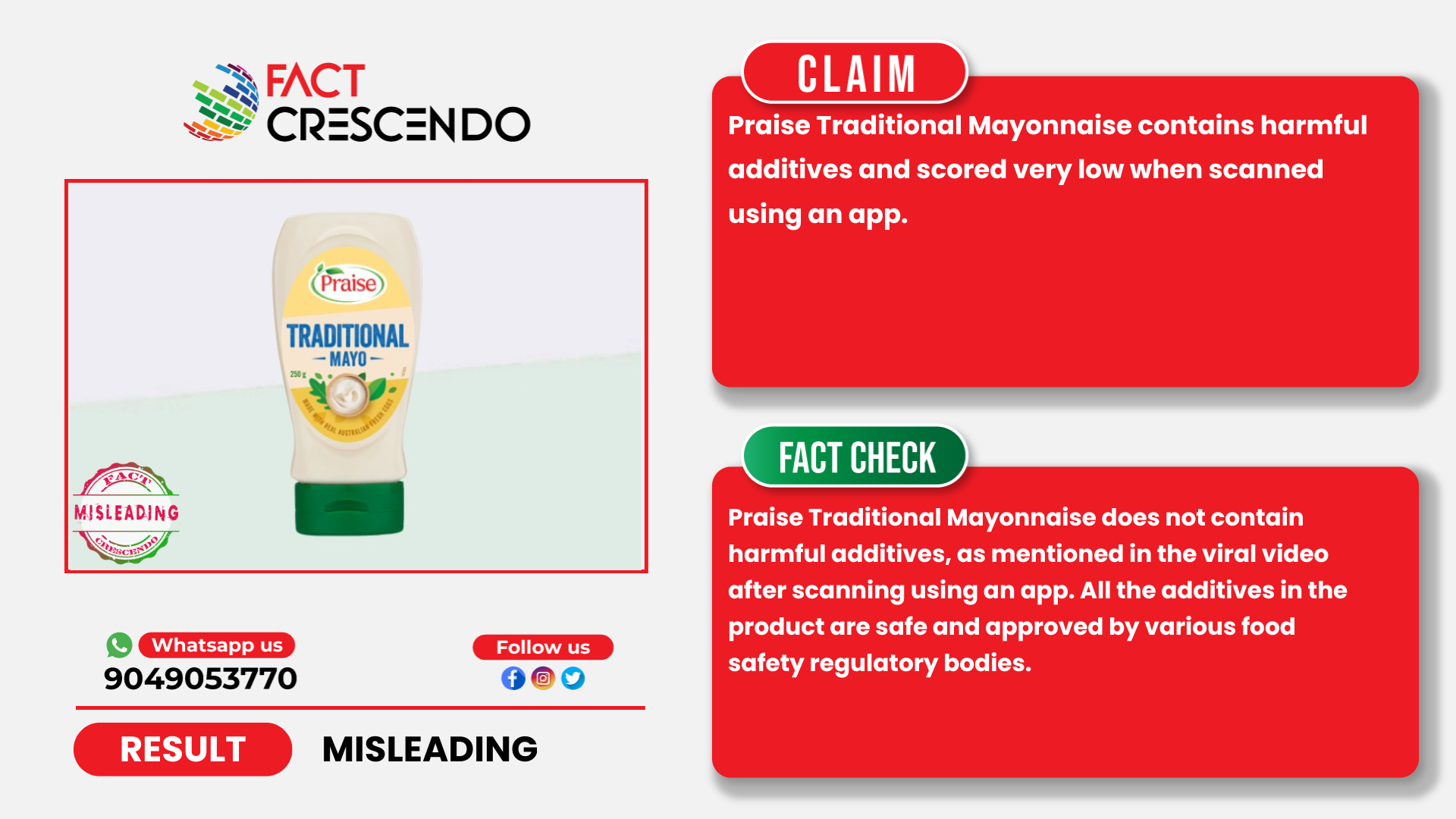
Social media posts are claiming that Praise Traditional Mayonnaise contains several harmful additives and warning consumers to avoid the product.
Fact Check-
Let’s check the list of ingredients and the fact about their safety.
Vegetable Oil (Antioxidant 320):
Antioxidant 320, also known as Butylated hydroxyanisole or E320 is a synthetic phenolic antioxidant used to prevent rancidity in edible oils and in foods rich in fats. It is also used as a chemical preservative. It is commonly used along with butylated hydroxytoluene (BHT), tertiary-butyl hydroquinone (TBHQ), and propyl gallate (PG), and/or combine with ascorbic acid, citric acid, and phosphoric acid to have a better antioxidative effect.
The Food and Drug Administration had listed BHA as Generally Recognized as Safe (GRAS) in 1958 and approved it as a food additive in 1961. FDA Commissioner Marty Makary said that the organization is taking necessary actions to ensure that chemicals in the foods remain safe and not causing any harm. He had further said, “The scientific community has raised significant concerns about some chemicals currently in the food supply. Once we complete our assessment of BHA, we expect to conduct similar assessments for butylated hydroxytoluene, a synthetic preservative known as BHT, and azodicarbonamide — a chemical used in yoga mats and also used as a dough conditioner.”
Vegetable Gum (405, 415):
Propylene Glycol Alginate (E405): United States Environmental Protection Agency (EPA) did an inert reassessment of Propylene Glycol Alginate and stated that it can also be used directly in foods as an emulsifier, flavoring adjuvant, formulation aid, stabilizer, surfactant, or thickener. It can be used in frozen dairy desserts, frostings, cheeses, gelatins and puddings, gravies and sauces, jams and jellies, baked products etc. All these fall under FDA regulations.
Propylene Glycol Alginate was evaluated by the FDA in 1972 and again reviewed in 1973 and 1974. It was then considered Generally Recognized as Safe (GRAS). The World Health Organization reviewed it in 1993. The studies did not find any information about previous hazard or risk assessment showing that this ingredient is dangerous.
During the study, WHO found that Propylene Glycol Alginate did not cause developmental or reproductive toxicity. It was also found to be non carcinogenic and genotoxic. The only adverse health effects found during animal studies are reduced growth and loose stools.
Xanthan Gum (E415): Xanthan gum is a hydrocolloid that stabilizes and thickens foods. Xanthan gum is made from bacteria found on the leaf surfaces of green vegetables, including broccoli, brussels sprouts, cauliflower, etc. The bacteria is fermented (much like cheese or wine), then dried and ground into powder. Xanthan gum is used in salad dressings, sauces, beverages, dairy products, syrups, etc.
According to the National Institute of Health, it is a food additive that is allowed and regulated by food safety authorities like the FDA and the EFSA. Different countries have set limits on how much can be used in foods. The European Union allows up to 2000 mg per kg of food, while the FDA allows up to 0.5% by weight. Foods containing xanthan gum must clearly mention it on the label so that people with allergies or sensitivities are informed. Xanthan gum is sold as a dietary supplement, especially for keto and low-carbohydrate diets.
Acidity Regulators (330, 514):
Citric Acid (E330): Citric acid (C₆H₈O₇) is a naturally occurring compound found in plants and animals. It appears as a colorless crystal or white powder. It can be obtained from natural sources like lemon or pineapple juice or produced through fermentation using specific fungi such as Candida or Aspergillus niger. The citric acid used in food must meet the quality and purity standards set by the Food Chemicals Codex. It is approved for use in food without any restrictions if prepared under good manufacturing practices guidelines.
Citric Acid (E330) is also listed under approved additives by Food Safety Standards in the UK.
Sodium Sulfate (E514):
Sodium sulfate, along with other sulfate salts, is approved for use in foods in the European Union and has been evaluated by international food safety authorities, including JECFA and the Scientific Committee on Food (SCF). Upon consumption, sulfate is absorbed by the body and is mostly removed through urine. It does not build up in body tissues. Studies showed that these sulfate additives have low toxicity and do not damage DNA. During animal studies it was found that very high doses caused diarrhea, which was not considered a serious health issue. Therefore, the experts concluded that these food additives do not pose a safety risk at their current approved levels, and there is no need to set an Acceptable Daily Intake (ADI).
Conclusion:
Fact Crescendo found the claim to be misleading. Praise Traditional Mayonnaise does not contain harmful additives, as mentioned in the viral video after scanning using an app. All the additives in the product are safe and approved by various food safety regulatory bodies.
Title: Do the Ingredients in Praise Traditional Mayonnaise Pose a Health Risk?
Fact Check By: Siddharth Sahu
Result: Misleading
