

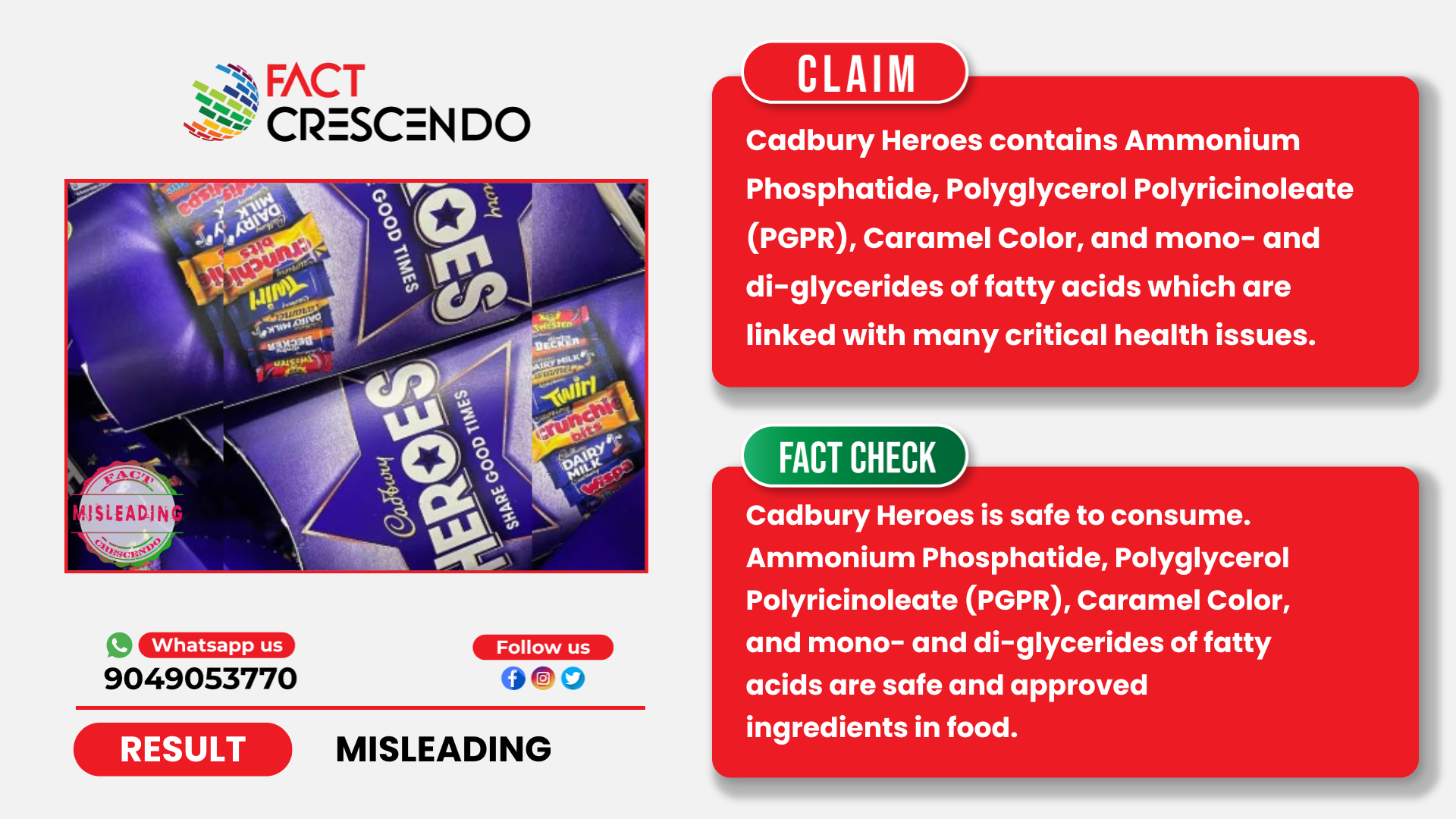
Cadbury Heroes is produced by a British confectionery brand Cadbury, which is now owned by Mondelez International. Cadbury Heroes was first launched in the UK in 1999. From there it gained its popularity across consumers of all ages.
However, recent claims on social media are suggesting that Cadbury Heroes contains many harmful additives which leads to serious health issues like kidney, bones, liver enlargement, cancer, inflammation and heart disease. Some of the ingredients mentioned in the viral video are Ammonium Phosphatide, Polyglycerol Polyricinoleate (PGPR), Caramel Color, and mono- and di-glycerides of fatty acids.
Fact Check-
Let’s check the facts of each ingredient mentioned in the viral video
Ammonium Phosphatide E 442:
Ammonium phosphatides (E 442) are synthetic, edible emulsifiers used primarily in the chocolate and confectionery industry to reduce viscosity and improve texture.
EFSA re-evaluated the ingredient to check if it is safe to eat. The panel used old research, scientific reviews, and extra data collected from the public. Even though some original studies were missing, they found enough information to judge safety.
It was found that even at very high doses, E 442 did not cause serious health problems like cancer, or harm to reproduction or development. The human body absorbs some of it and the rest is passed out in faeces. Low short-term toxicity was noticed but scientists did not find it to damage DNA. Because of this, EFSA kept the same Acceptable Daily Intake (ADI), i.e. 30 mg per kg body weight per day. This amount is considered safe to eat every day.
According to the EFSA estimation, most groups of people consume below this safe limit. Only toddlers might slightly exceed it in a worst-case scenario. But in more realistic scenarios, everyone’s intake is below the ADI. so EFSA said E 442 is not a safety concern at current uses.
The U.S. Food and Drug Administration (FDA) had approved the use of Ammonium Phosphatide as an emulsifier in chocolate and vegetable fat coatings at up to 0.7 % of the product. The ingredient is safe when used as intended.
E 476 Polyglycerol Polyricinoleate (PGPR):
Polyglycerol Polyricinoleate (PGPR) is approved as a food additive in the European Union with specific purity standards set by Commission Regulation. It was first evaluated by the FAO/WHO’s JECFA in 1969 and 1974, which established a safe daily intake of 0-7.5 mg per kilogram of body weight.
PGPR was also evaluated by the Nordic Council of Ministers. It was concluded that ‘the toxicological data available to JECFA in 1973 or to SCF in 1977 did not include all the data. However, more recent studies support the safety of PGPR at these levels.
E 471 Mono- and Diglycerides of Fatty Acids:
EFSA reviewed the safety of mono- and di-glycerides of fatty acids (E471), a common food additive used as an emulsifier. The panel found that in the body, E471 is broken down into glycerol and fatty acids, which are normal substances already evaluated as safe. Studies conducted for short-term and long-term effects showed no harmful effects, including no evidence of cancer risk, genetic damage, or problems with reproduction or development. Based on all the evidence, EFSA concluded that E471 is safe at current usage levels and does not need a specific daily intake limit.
E 150d Caramel Color:
The scientific panel reviewed the safety of four types of caramel colours used in foods and found that they are generally safe when consumed within set limits. These colours are made by heating sugars in different ways. Based on animal studies, the panel set a combined safe intake level for all caramel colours except for E150c. Due to possible effects on the immune system, a lower limit of E150c was set by the panel. The panel clarified that key harmful substances found in caramel colours are not currently a major concern.
What is 4-MEI found in E150d:
4-methylimidazole (4-MEI) is a chemical compound that forms as a byproduct at low levels in some foods and beverages during the normal cooking process. 4-MEI may form when coffee beans are roasted and when meats are roasted or grilled. It also forms while preparing Class III and Class IV caramel color.
According to the FDA, there are no immediate or short-term health risks presented by 4-MEI at the levels expected in food. In 2007, the National Toxicology Program (NTP) issued reports summarizing the results of toxicological testing conducted on 4-MEI in rats and mice. A 2-year study in rats was inconclusive regarding carcinogenicity, but a 2-year mouse study showed an increased incidence of certain lung tumors. These NTP studies were conducted in rodents at levels of 4-MEI that far exceed current estimates of human exposure to 4-MEI from the consumption of food with or without the addition of Class III or Class IV caramel coloring.
In March 2020, a study tested whether 4-MEI affects reproduction and development in rats and found some effects at very high doses. However, these doses were much higher than what people normally consume through food.
Conclusion:
Fact Crescendo found the claim to be misleading. Ammonium Phosphatide, Polyglycerol Polyricinoleate (PGPR), Caramel Color, and mono- and di-glycerides of fatty acids are approved ingredients in food. The presence of these ingredients in Cadbury Heroes is safe.
Title:Ingredients used in Cadbury Heroes are safe and approved, Viral claim is misleading.
Fact Check By: Siddharth SahuResult: Misleading
