

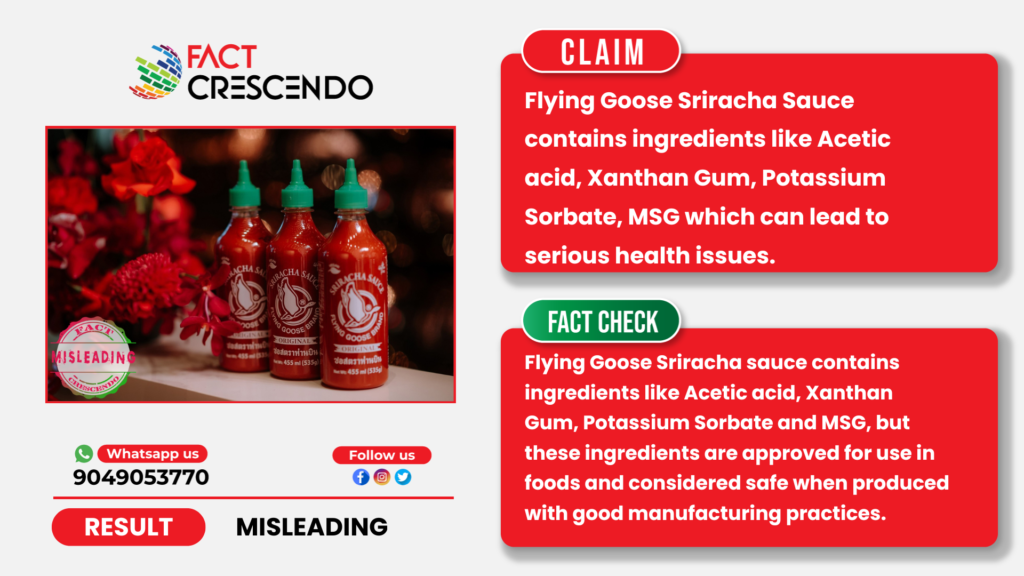
Flying Goose Sriracha is a Thai Chilli sauce that originated in Thailand. It is made using various ingredients like red chilies, garlic, vinegar, sugar, salt etc. It is now widely available in international markets and one of the common sauces in houses.
Recently, social media users were found pointing out that Flying Goose Sriracha sauce contains ingredients like acetic acid, xanthan gum, potassium sorbate and MSG which are highly unsafe for human consumption.
Fact Check-
First, we check the list of ingredients used in sriracha sauce. We found that, it contains Chilli (61%), Sugar Syrup, Salt, Garlic, Water, Acids (Acetic Acid: E260, Citric Acid: E330), Flavour Enhancer (Monosodium Glutamate: E621), Stabiliser (Xanthan Gum: E415), Preservative (Potassium Sorbate: E202).
As mentioned in the post, the product contains Acetic acid, Xanthan Gum, Potassium Sorbate and MSG.
Let’s check the facts about all these ingredients.
Acetic Acid: Acetic acid is a colourless liquid with a sharp, vinegary smell. It can be found in kitchen, food packaging and cosmetics as well. In its pure form, it is called glacial acetic acid. This version is highly concentrated and can burn the skin on contact. But when diluted, it becomes much safer and is used across the food and health industries.
According to the FDA, acetic acid is generally safe for use in food if it’s food-grade and used properly. However, if a food contains acetic acid, the label should clearly list it by name acetic acid or diluted acetic acid. Using acetic acid in place of real vinegar in products like pickles etc. where consumers expect vinegar is considered misleading.
The U.K. Health Security Agency states that humans naturally produce small amounts of acetic acid. It plays an important role in the metabolism of fats and carbohydrates in the body. It is naturally present in some unprocessed foods including fruit and is present in some foods as an additive. There may also be exposure from the use of household products that contain acetic acid. Exposure to low levels of acetic acid in the environment, as part of a normal diet and from the correct use of household products do not cause adverse health effects. Exposure to higher levels of acetic acid is more likely to occur in an occupational setting.
Exposure to dilute solutions of acetic acid may cause irritation. Inhalation of acetic acid vapours may cause irritation of the eyes, nose and throat and cough. Exposure to more concentrated solutions of acetic acid (less than 25%) can cause corrosive damage.
But, low level exposure to acetic acid from the diet or from the correct use of household products that contain acetic acid would not be expected to cause adverse health effects.
Xanthan Gum: Xanthan gum is a hydrocolloid that stabilizes and thickens foods. Xanthan gum is made from a bacteria found on the leaf surfaces of green vegetables, including broccoli, brussels sprouts, cauliflower etc. The bacteria is fermented (much like cheese or wine), then dried and ground into powder. Xanthan gum is used in salad dressings, sauces, beverages, dairy products, syrups etc.
According to the National Institute of Health, It is a food additive that is allowed and regulated by food safety authorities like the FDA and the EFSA. Different countries have set limits on how much can be used in foods. The European Union allows up to 2000 mg per kg of food, while the FDA allows up to 0.5% by weight. Foods containing xanthan gum must clearly mention it on the label so that people with allergies or sensitivities are informed. Xanthan gum is sold as a dietary supplement, especially for keto and low-carbohydrate diets.
Potassium Sorbate: Potassium sorbate is a chemical food additive which is used as a preservative in foods. It prevents the growth of molds, fungi and yeast. It can be found in many food products like cheese, chewing gums, processed meat, citrus fruits, wine and in personal care products etc.
According to a report, regulatory agencies such as the FDA, the United Nations Food and Agriculture Organization, and the European Food Safety Authority (EFSA) have determined that potassium sorbate is “generally regarded as safe,” (GRAS). When one eats potassium sorbate as a food additive, it passes through the system harmlessly as water and carbon dioxide. It does not accumulate in the body.
The European Food Safety Authority (EFSA) reviewed the safety of sorbic acid and its salts like potassium sorbate and calcium sorbate, which are commonly used as food preservatives in the EU. These additives were already approved under EU law and an acceptable daily intake (ADI) of 25 mg per kg of body weight per day was set. Studies showed that potassium sorbate is easily absorbed by the body and mostly broken down into carbon dioxide after digestion. Animal studies did not show harmful effects even at very high doses. No evidence suggesting that potassium sorbate damages DNA was found.
MSG: MSG consists of sodium and L-glutamate, which enhance the umami flavor without altering salt perception. According to regulatory authorities like the U.S. FDA, MSG is classified as “Generally Recognized as Safe” (GRAS). The FDA recommends keeping MSG intake below 0.5 grams per meal, as larger amounts (over 3 grams) may cause mild, transient symptoms in some individuals, such as headaches or flushing. However, most foods with added MSG contain less than 0.5 grams per serving, making overconsumption unlikely. Similarly, the European Food Safety Authority (EFSA) and the World Health Organization (WHO) affirm MSG’s safety within regulated limits. FDA recommendations can be referred here, and European Union guidance can be found here.
Upon further research, we found that in 2021 Flying Goose Sriracha Mayo sauce was recalled from the market. Centre for Food Safety, Hong Kong had reported that the same batch of the sauce had failed to mention Soya as an ingredient in its label which could have led to serious health issues to those who were allergic to the ingredient.
Conclusion:
Fact Crescendo found the claim to be misleading. Flying Goose Sriracha sauce contains ingredients like Acetic acid, Xanthan Gum, Potassium Sorbate and MSG, but these ingredients are approved for use in foods and considered safe when produced with good manufacturing practices.
Title:Misleading information about Flying Goose sriracha sauce containing carcinogenic ingredients.
Fact Check By: Siddharth SahuResult: Misleading
