

Insects like mosquitoes are so common in tropical countries. People use various repellents to avoid mosquitoes and insects. However, some chemicals used as repellents are sparking controversy related to the health effects of the ingredients. In this article, we are considering mosquito coils and their health impacts and how to use them in safer ways.
Social Media Posts
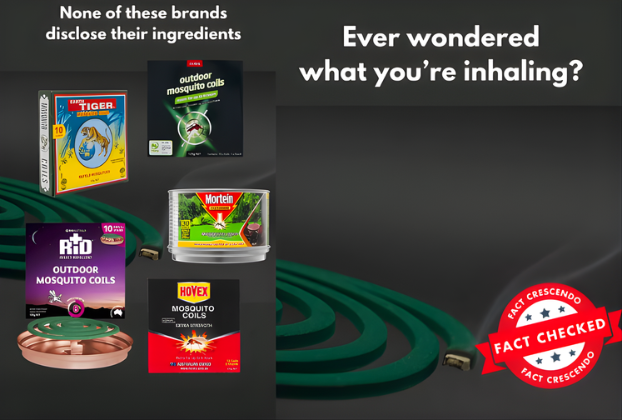
Social media posts in Australia say the insecticide in mosquito coils is harmful to humans, aquatic life, and even bees. Therefore, we should avoid the usage of mosquito coils and seek alternatives. And further say that mosquito coil products do not reveal the ingredient lists and also the products are not regulated. The post names well-known brands such as RID, Mortein, Coles, Hovex, and Earth Tiger, raising concerns among consumers.
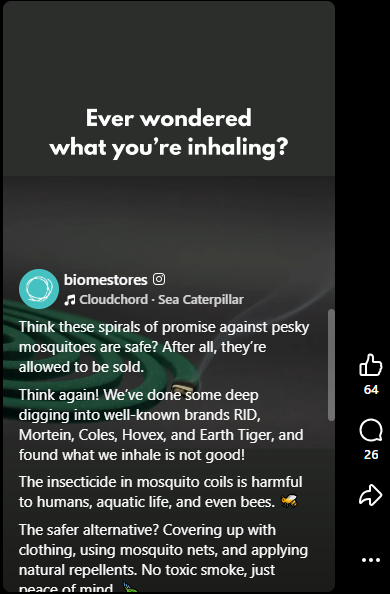
We decided to do a fact check on this.
Explanation
Do mosquito coils contain insecticides that are harmful to human health when used as directed?
Let’s first consider the ingredients of famous mosquito coils explained in the post.
Ingredients of RID mosquito coils can be reached here
Ingredients of Mortein mosquito coils can be reached here
Ingredients of Cole mosquito coils can be reached here
Ingredients of Hovex mosquito coils can be reached here
Ingredients of Earth Tiger mosquito coils can be reached here
Australian coils contain pyrethroid insecticides (primarily d-allethrin) that, when used as directed, are considered low-risk to people. Experts note that “the insecticide products used in coils are generally considered safe,” but the smoke particulates from burning a coil (especially indoors) are the main concern. In fact, a study equated the fine particles from one coil’s smoke to smoking 75-137 cigarettes. This means coils should be used outdoors or in well-ventilated areas. All mosquito coils sold in Australia must carry an APVMA (Australian Pesticides and Veterinary Medicines Authority) registration number. APVMA’s risk assessment explicitly considers human toxicity and exposure. Health authorities echo this: South Australian Health advises that all registered repellents are “safe…when used as directed”. In practice, coils used per label (and not burned near people indoors) do not pose a known direct health hazard under normal conditions.
Are the active ingredients in mosquito coils toxic to aquatic organisms or pollinators like bees?
The main coil insecticide, d-allethrin, is highly toxic to aquatic organisms. The Mortein coil safety data classifies it as “Toxic to aquatic life with long lasting effects” (GHS Category 2). Independent pesticide data also states that allethrin is “moderately toxic to fish, honeybees and earthworms”. In plain terms, this means if coil material or residue reached water bodies or bee hives, it could harm them. However, typical use limits exposure: coils are generally burned outdoors, well away from waterways and hives, and users are instructed to “avoid release to the environment”. If used responsibly, the environmental hazard is minimal.
Do mosquito coil manufacturers really hide ingredients under “trade secret” claims, or are ingredients regulated and disclosed according to law?
By law, coil product labels must list all active ingredients by name and concentration (in Australian coils, this is usually the pyrethroid). Non‑active (inert) ingredients do not have to be listed on the retail label.
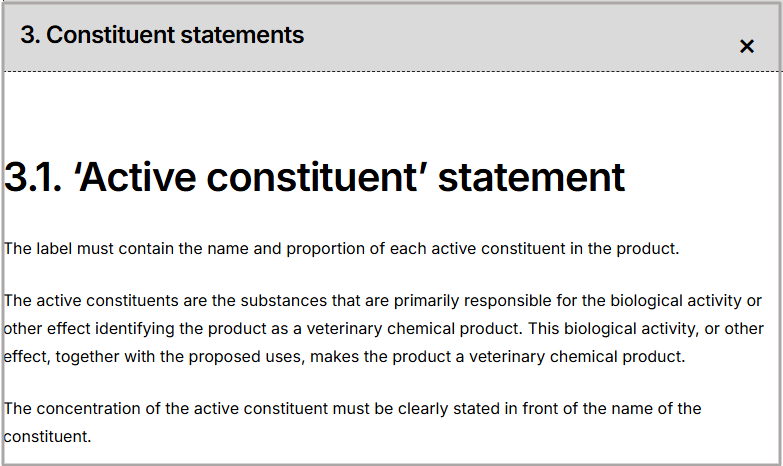
APVMA guidelines explicitly treat full formulation details (all ingredients and processes) as confidential commercial information . Thus manufacturers often mark the rest of the formula as “trade secret.” This practice is allowed under APVMA rules – it does not mean safety is ignored. The regulator still reviews the overall mixture’s safety based on toxicology and exposure data . In summary, active ingredients aren’t hidden (they’re on the label), but proprietary inert components can be withheld by law
Are mosquito coils from different brands essentially identical and produced in the same factories in Indonesia and Malaysia?
Many Australian coils are imported from Southeast Asia. For example, Quality Coils Industries (QCI) in Malaysia is a leading OEM mosquito‑coil maker serving global brands . Packaging and import records show some brands are made in Malaysia or Indonesia. For instance, Earth Tiger coils are marked “Made in Malaysia” and Hovex coils come from Indonesia. Coles‑brand coils (sold by retailer Coles) and RID coils are supplied by the same Australian company (Cavalieri) and are produced overseas (Malaysia). In general, coils use very similar formulations (pyrethroid insecticide plus plant‑based powder, filler and dye). However, not all brands are identical. Variations exist in exact formulation and manufacturing source. Without internal industry data it’s hard to prove any brand-pair is the same product. It’s reasonable to say that a few foreign factories supply multiple brands, but each product must separately meet APVMA requirements.
Are mosquito coils poorly regulated, with oversight limited only to pest-killing claims rather than human or environmental safety?
Mosquito coils in Australia are not unregulated. They are classified as pesticides, so each product requires APVMA registration . APVMA law mandates that approval depends on meeting safety criteria. In fact, the AgVet Code explicitly puts “the health and safety of human beings, animals and the environment” as the first priority in pesticide regulation . APVMA’s scientific risk assessment evaluates toxicity and expected exposure, then imposes any needed conditions (label instructions, usage limits, cancellation) to ensure safe use . Thus, contrary to the viral post, APVMA does assess human and environmental safety – not just “does it kill mosquitoes.” If a coil product were unsafe, it would not receive (or would lose) registration. For example, APVMA periodically reviews actives (and can restrict or remove them if risks emerge) under its chemical review process.
How do mosquito coils compare with other mosquito repellents in terms of safety regulation and risk assessment?
All mosquito repellents in Australia – sprays, lotions, candles, plug‑ins and coils – must be APVMA‑approved (or exempt if truly low‑risk botanicals). Registered topical repellents (DEET, picaridin, lemon eucalyptus) undergo a similar safety review and are deemed safe for general use .The main difference is exposure type: lotions apply on skin, coils burn in air. Coils produce smoke (which can aggravate asthma or be a fire hazard) whereas sprays do not. Health agencies often advise using both methods together: for example, SA Health explicitly recommends using outdoor coils in combination with skin repellents for best protection . Internationally, agencies like the US EPA similarly require repellent products to be registered for safety and effectiveness . In short, coils are not held to a weaker standard than sprays – they face the same scrutiny (just with different use instructions).
Conclusion
The viral claims mix facts with exaggeration. It is true that coil smoke contains chemicals and particulates, and that the active insecticides can harm aquatic life and insects at high doses . It is also true that manufacturers legally withhold inert ingredients from public view . But it is misleading to imply Australian coils are “unsafe” or “unregulated.”
In reality, APVMA has evaluated these products and requires prominent labeling of any hazards. When used outdoors as directed, coils do not pose a significant human health risk . The concerns about aquatic life and bees are valid in principle but largely averted by normal usage patterns. Australian mosquito coils with APVMA registration are deemed safe if instructions are followed; the storm of viral warnings overstates the dangers.
Title:Should we totally avoid using mosquito coils?
Fact Check By: Rashmitha DiwyanjaleeResult: Misleading
