

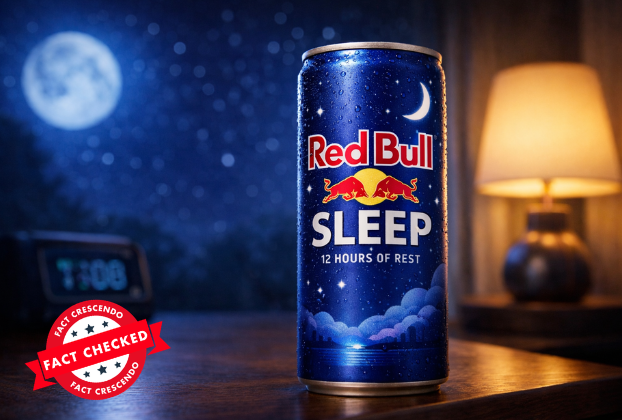
A claim circulating on social media alleges that Red Bull is developing a new “sleep drink” that could provide up to twelve hours of uninterrupted rest. The claim has gained attention in part because it contrasts with Red Bull’s branding as an energy drink company. However, based on a review of publicly available information and official sources, this claim remains unconfirmed and may be inaccurate.
Social Media Posts
The claim appears to have gained traction through widely shared posts and images on Instagram and Facebook. These posts often show a product mockup labeled “Red Bull Sleep,” along with statements that it can “guarantee 12 hours of rest.”
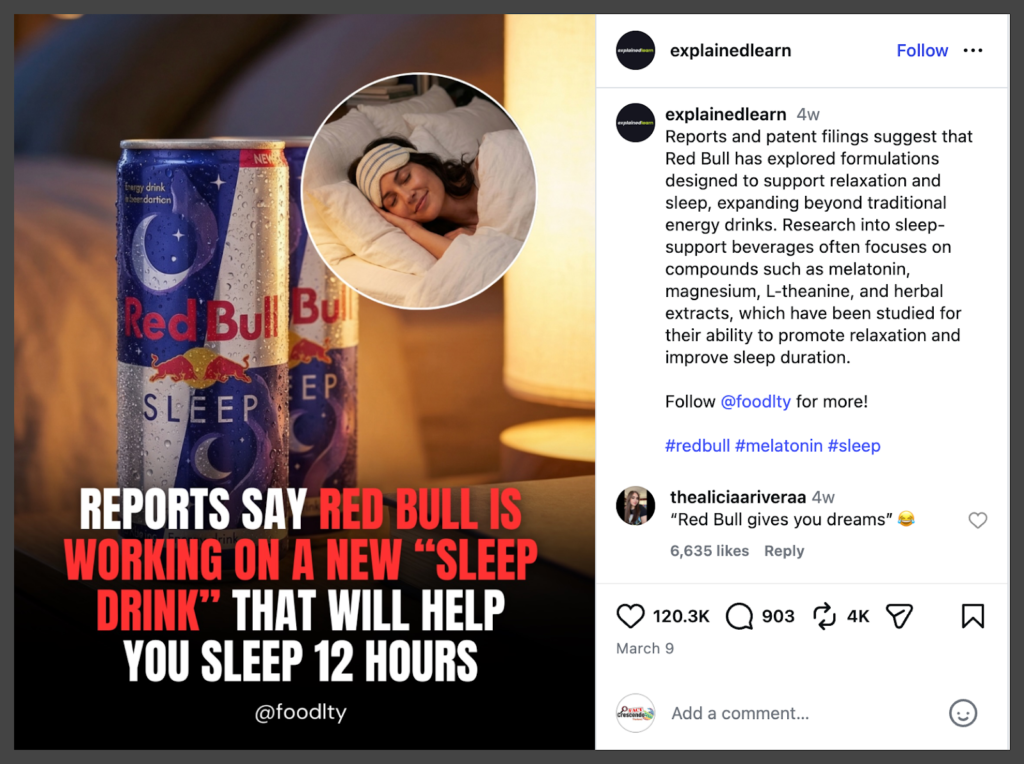
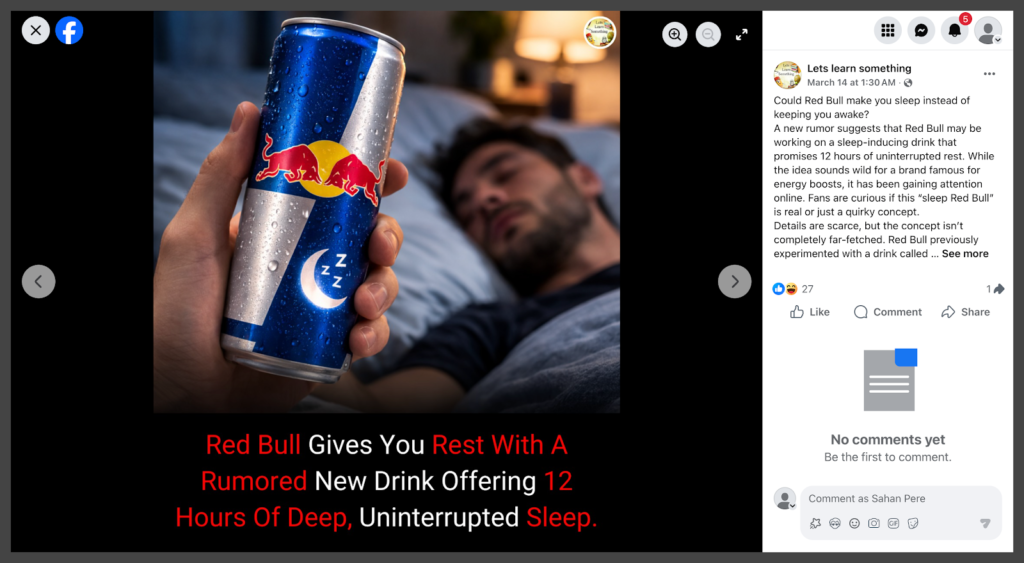
Fact Check
No Official Announcement from Red Bull
As of April 2026, there is no publicly available confirmation from Red Bull that it is developing a sleep-focused beverage. No press releases, product listings, or announcements appear on the company’s official website or verified channels.
In the absence of such sourcing, the claim cannot be verified. For a global brand like Red Bull, major product launches are often accompanied by coordinated marketing and official disclosures, which have not been identified in this instance.
We contacted Red Bull for clarification, but as of publication, we have not received a response.
Scientific and Regulatory Constraints
Beyond the lack of evidence, the claim also clashes with what sleep science and advertising rules actually support. Sleep does not occur as a perfectly uninterrupted 12-hour block in real-world or clinical settings, and there is no credible evidence that any ingredient can reliably guarantee that outcome. Research on sleep duration suggests that even with extra time in bed, people usually settle around roughly 8 to 9 hours of sleep, with normal brief awakenings. Common “sleep” ingredients also tend to have limited effects. Reviews of melatonin, for instance, generally find small benefits such as falling asleep a few minutes faster, not dramatic increases in total sleep or a promise of uninterrupted rest.
Regulation points in the same direction. In the European Union, permitted health claims are tightly limited under Regulation (EU) No 432/2012. For melatonin, the allowed wording is narrow and dose-specific, such as contributing to a reduction in time taken to fall asleep (typically at 1 mg per serving). The European Food Safety Authority (EFSA) has assessed this evidence and does not support broader claims about sleep duration or “uninterrupted” sleep. Related EU guidance likewise focuses on sleep onset, not guaranteed hours of sleep.
In the United States, the FDA generally allows only non-specific “structure/function” statements like “supports sleep,” and it does not permit precise, guaranteed outcomes such as “12 hours of uninterrupted sleep.”
Overall, the combination of weak scientific support and strict limits on health-claim wording makes the viral “guaranteed 12 hours” framing a strong red flag for misinformation rather than a credible product claim.
Red Bull’s Product Portfolio
Red Bull’s current product lineup focuses primarily on energy drinks and performance-oriented beverages. On its official product pages, the brand emphasizes caffeinated formulations intended to support alertness and energy, and it does not feature sleep aids or relaxation-focused products.
While the company has introduced sugar-free variants, flavored editions, and organic soft drinks, these offerings still align with its broader positioning around energy and lifestyle performance rather than sleep-oriented products, and no sleep- or relaxation-focused product has been announced or listed by the company to date.
Part of the confusion may stem from loosely related developments involving individuals previously associated with Red Bull. A former Red Bull executive, Hans Vriens, independently launched a herbal sleep drink called “Snoooze” around 2019, using ingredients such as passion flower and lemon balm. However, this product was not developed, owned, or endorsed by Red Bull, and there is no evidence of any formal link to the company’s product strategy, nor does it indicate any current or planned involvement by Red Bull in the sleep beverage category.
Conclusion
The available evidence does not support the claim that Red Bull is developing a sleep drink that would “guarantee” twelve hours of uninterrupted rest. At this time, there is no official announcement or other credible documentation from Red Bull, and there is no clear scientific basis for the specific claims circulating online. Until verified information is published through Red Bull’s official channels, the claim should be treated as an unverified claim and likely a viral hoax rather than a confirmed product development.

Title: Fact Check: No evidence Red Bull is developing a “sleep drink” that guarantees 12 hours of sleep
Written By: Fact Crescendo Team
Result: False
