

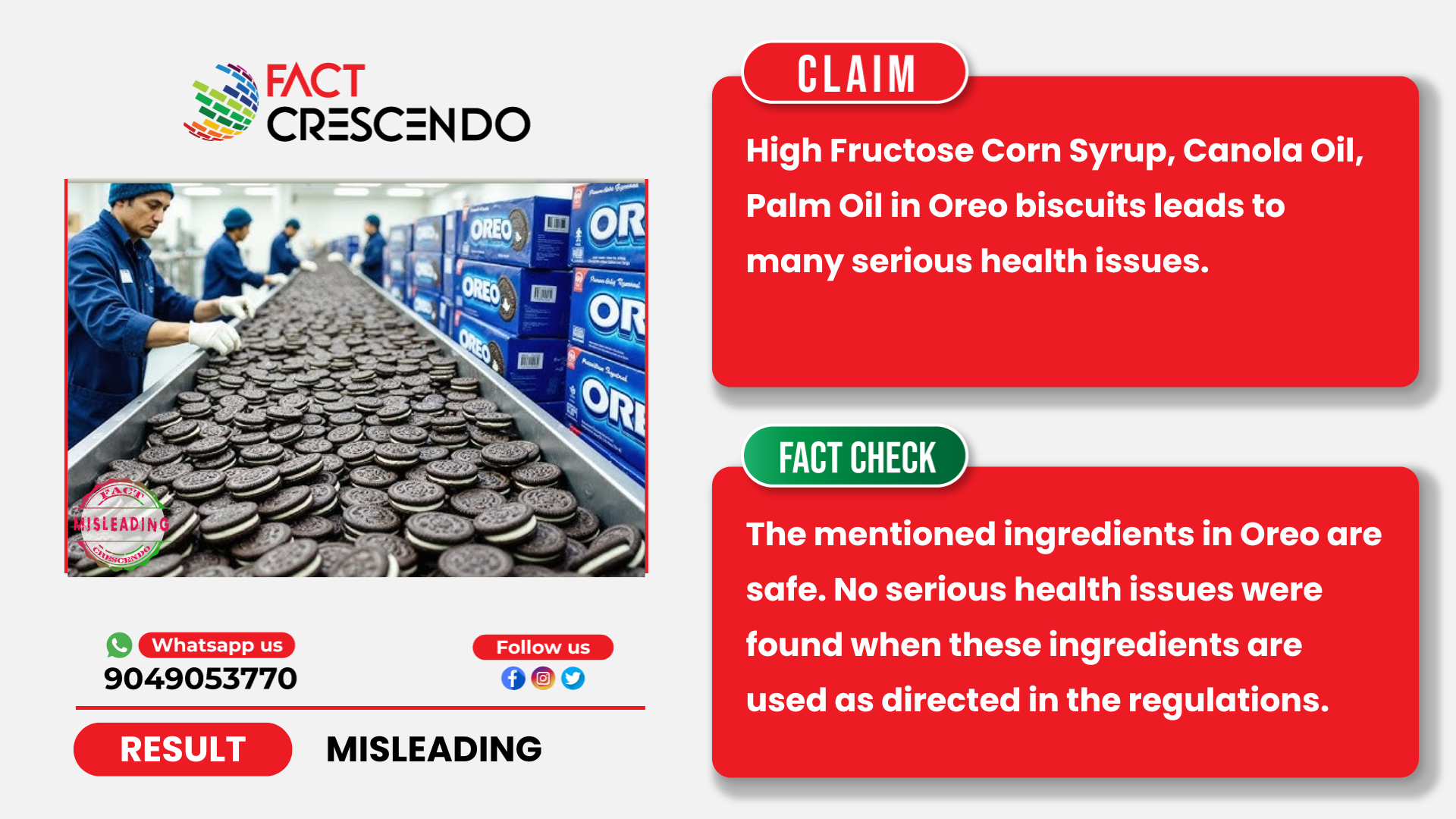
A viral social media post had claimed that ingredients like High Fructose Corn Syrup, Canola Oil and Palm Oil in Oreo biscuits are harmful to health. The claim suggests that these ingredients lead to diabetes, fatty liver and many chronic issues.
However, Fact Crescendo found the claim to be misleading. The mentioned ingredients in Oreo are safe. No serious health issues were found when these ingredients are used as directed in the regulations.
Fact Check-
First we checked the ingredients used in Oreo biscuits. We found that it contains refined wheat, sugar, fractionated fat, palmolein, cocoa solids, inverted sugar etc. We did not find High Fructose Corn Syrup (HFCS) listed as an ingredient in Oreo in India. However, the product contains HFCS in many other countries.
Let’s check the safety of the ingredients mentioned in the video.
High Fructose Corn Syrup: High fructose corn syrup (HFCS) is a sweetener made from corn starch by converting glucose into fructose using an enzyme. It comes in two main types: one with about 42% fructose and another with 55% fructose. HFCS has been listed as generally recognized as safe (GRAS) substance when prepared and used under good manufacturing practice under FDA rules.
A research study on mice showed that high fructose corn syrup (HFCS) may enhance tumor growth by increasing fatty acid production in tumors. Tumors in HFCS-treated mice had higher levels of fatty acids like palmitic acid and stearic acid and showed changes in genes related to fatty acid metabolism. The study also found that HFCS promotes tumor growth by boosting fatty acid synthesis. When the key enzyme for fatty acid production (FASN) was removed in these mice, HFCS could no longer enhance tumor growth, suggesting that fatty acid production plays a key role in the process.
Another study found that too much fructose might lead to obesity and colon cancer in mice. Dr. Goncalves from Weill Cornell Medicine said it’s still unclear whether large amounts of high-fructose corn syrup (HFCS) actually reach the colon in humans. That’s because most of it might be absorbed in the digestive system. In mice, the digestive system is shorter, so it’s easier for HFCS to reach the colon. Dr. Goncalves suggested more research on this is needed.
But, the FDA stated that there is no evidence that HFCS is less safe than other sweeteners like sucrose (table sugar) or honey, which have similar amounts of glucose and fructose. However, the 2010 Dietary Guidelines recommend limiting all added sugars, including HFCS, to maintain a healthy diet, a guideline which the FDA fully supports. HFCS has been listed as generally recognized as safe (GRAS) substance when prepared and used under good manufacturing practice under FDA rules.
Canola Oil: Canola oil is healthy because it is low in unhealthy saturated fats (only 4%) and high in good fats like oleic acid (55%) and other polyunsaturated fats. Unlike older rapeseed oils, canola oil has very low levels of erucic acid, which was once thought to be harmful. Because of its healthy fat profile, canola oil fits well with dietary guidelines aimed at reducing heart disease risk. It’s the most commonly used oil in Canada and is considered safe to eat by the U.S. FDA.
According to the Canola Council Canada’s website, Canola oil is good for the heart and may help lower the risk of heart disease when used instead of fats high in saturated fat. The U.S. FDA allows the use of canola oil. There are both genetically modified (GM) and non-GM types of canola. No matter if the canola is genetically modified or not, the oil is exactly the same because all proteins are removed during processing. Canola oil is considered safe to eat, even for babies in infant formula.
Palm Oil: The U.S. Food and Drug Administration had found that during high temperature refining of palm oils two contaminants 3-MCPD esters and glycidyl esters can form. These substances are considered harmful to the kidney and have potential link cancer. The FDA is actively researching these contaminants to better understand their occurrence in foods and to develop methods for reducing their levels during oil processing.
Palm oil is approved for use in food. The FDA recommended the manufacturers to minimize the presence of these contaminants to ensure safety of the consumers.
Several studies were conducted to check the safety of palm oils, palm olein etc after large scale frying. It was found that when these oils are used in factories for making potato chips or french fries, they stay in good condition even after many hours of continuous use. These oils were found to show low damage, low acidity and stable quality. In fast-food cooking, these oils remain safe and usable even after several days if it was used under acceptable smoke point value.
Malaysian Palm Oil Council (MPOC) has clarified that Palm oil is safe for people to consume when used within recommended amounts. According to many scientific studies, it does not cause heart disease or cancer. Palm Oil Council had also pointed out that it contains antioxidants like Vitamin E, and the concerns about processing contaminants like 3 MPCD are low and within international safety limits
Conclusion:
Fact Crescendo found the claim to be misleading. When High Fructose Corn Syrup, Palm oil and Canola oil are used within established limits and prepared with good manufacturing practices, no serious health issues were found.

Title: Viral claim about Oreo biscuits is based on partial and misleading information
Written By: Siddharth Sahu
Result: Misleading
