

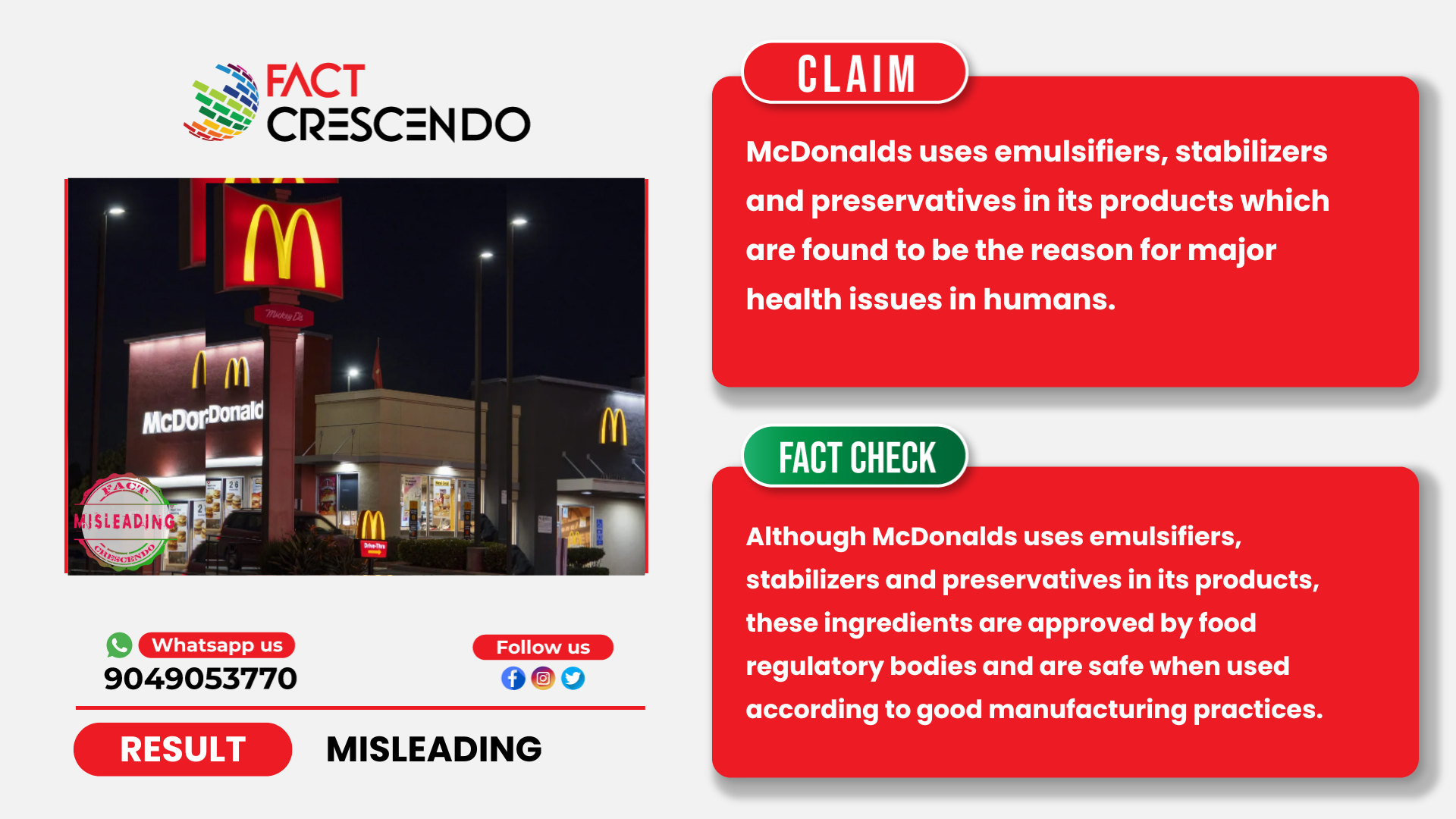
Claims on social media suggest that McDonalds hides the truth about their foods from the valuable customers. Their food contains harmful chemicals as ingredients which causes serious health issues.
The claim is, “McDonalds sausages contain ingredients like E450, E451, Dextrose; cheese contains emulsifiers and various colors; muffins contain calcium propionate, E472e and wrap contains stabilizers and preservatives. These ingredients are harmful chemicals and are not fit for human consumption.”
Fact Check-
Sausage:-
First, we checked the ingredients used in the sausage by McDonalds. We found that the sausage patty contains pork, water, salt, spices, dextrose, sugar, rosemary extract, and natural flavors. However, we found dextrose mentioned in the ingredient list.
Is the use of Dextrose in food safe?
Dextrose is a type of sugar that usually comes from corn or wheat. It can be quickly used as a source of energy by the human body. It is often used in foods as an artificial sweetener or a preservative. It is generally found in sauces, chips, canned foods, pickles, jams etc. As Dextrose has a high glycemic index, it can increase blood sugar quickly and lead to diabetes. Weight gain, heart disease etc.
However, the FDA considers Dextrose as safe when it is used within the set limits. The FDA had allowed the use of dextrose not only as a sweetener but also as an anticaking agent, flavor enhancer, coloring adjunct etc.
Food Safety and Standards Authority of India (FSSAI) had also approved the use of dextrose in many consumable products like dairy whitener, ice cream, kulfi, foods for infants, synthetic syrup etc.
Cheese:-
Further, we found that McDonalds uses pasteurized American cheese. Its ingredients are milk, cream, water, sodium citrate, salt, cheese cultures, citric acid, enzymes, soy lecithin, color added. In the mentioned list sodium citrate and soy lecithin are emulsifiers.
Is Sodium Citrate and Soy Lecithin approved ingredients to be used in foods?
Soy Lecithin: Lecithin is a naturally occurring mixture of the phosphatides of choline, ethanolamine, and inositol, with smaller amounts of other lipids. It is Generally Recognized as Safe (GRAS) under FDA regulation. According to this regulation, lecithin can be used in food with no limitations other than adhering to the current good manufacturing practices.
The EFSA re-evaluated lechitins (E 322) and concluded that it is safe for consumption. Further, it stated that Acceptable Daily Intake (ADI) value is not required for lechitins as exposure levels from food consumption do not pose a safety concern for the general population, including infants and young children.
Sodium Citrate: Sodium citrate is a salt of citric acid and has been approved by the U.S. Food and Drug Administration (FDA) for use in food and food contact products. It is considered as generally Recognized as Safe (GRAS).
This ingredient is listed as a permitted food additive in the European Union. Its safety has been evaluated and allowed for use in foods.
Muffin:-
Calcium Propionate: EFSA reviewed the safety of Calcium propionate and other propionic acid and its salts. These substances also occur naturally in food. Earlier, the panel had not set an intake limit as the ingredient is considered low risk. Some side effects were seen in animal studies, but the main one occurred in an organ that humans do not have. So it was not considered relevant.
Other changes seen in dogs happened only at high levels. EFSA found no concern about cancer or DNA damage. The panel also found that the amount of calcium propionate people consume from food additives is much lower than levels that caused effects in studies. EFSA concluded that propionic acid and its salts including calcium propionate are safe at the levels currently allowed in food.
According to the FDA, this ingredient is mainly used as an antimicrobial agent and antioxidant which helps prevent the growth of mold and some bacteria and also protects the food from oxidation. It is generally recognized as safe (GRAS) when used in foods according to good manufacturing practices
Mono- and diglycerides diacetyl tartaric acid esters (E472e): Mono- and diglycerides diacetyl tartaric acid esters are used in foods mainly as an emulsifier and texturizer. The FDA recognized E472e as GRAS when used according to good manufacturing practices.
Wrap:-
McDonalds has a variety of wraps and each wrap has plenty of ingredients. So, you can read about the safety of some of the ingredients of the McDonalds wrap below.
Sodium Phosphate: Sodium phosphate is approved for use in foods in both the United States and the European Union. In the US, the FDA considers it safe when used appropriately. In the European Union, it is commonly used as an acidity regulator, stabilizer, texture improver, and shelf-life enhancer. Phosphate additives, including sodium phosphate, are authorized in a wide range of food categories such as bread and bakery products, processed cheese, sugars and syrups, infant foods, and beverages.
Sodium phosphates (mono-, di-, and tri-sodium phosphate) are food additives mainly used to control acidity (pH) and act as stabilizers in processed foods. They help fruits and vegetables keep their color and texture, stop foods from clumping, and improve moisture retention. These additives are also used in baked goods, cereals, beverages, and dairy products. The FDA recognizes them as Generally Recognized As Safe (GRAS). However, a few studies have shown that eating too much phosphate may be harmful for the kidney, bones, and heart.
Guar Gum: Guar gum is a fine powdered fiber created from the ground seeds of the guar plant. It is used in food products as a thickener and a binder. It is created by de-husking, then milling, and finally sorting the guar bean. It is then ground into a powder form. Guar gum can be found in soups, stews, ice cream, yogurt, and marinades. It is also used in plant-based milks such as flax, almond, coconut, soy, and hemp.
The ingredient is recognized by the U.S. FDA as generally safe for use in foods till it meets quality and purity standards laid down in the Food Chemicals Codex. It is commonly used in many food products such as baked goods, dairy items, sauces, soups, and jams to act as a thickener, stabilizer, emulsifier, or texture-improving agent. The regulation allows its use only within specified limits for different food categories to ensure consumer safety.
According to the National Institute of Health, guar gum is considered safe when used in normal amounts in food. It is generally used in very small quantities, usually less than 1% of the food product. Studies showed that at this normal level, no harmful effect from the ingredient was found. Some safety concerns were noticed during animal studies where high amounts of Guar gum was consumed (about 10-15% of the diet). At this high level, digestive problems due to excessive thickness in the gut was noticed. However, this level is far higher than what humans consume through food.
Conclusion:
Fact Crescendo found the claim to be misleading. Although McDonalds uses emulsifiers, stabilizers and preservatives in its products, these ingredients are approved by food regulatory bodies and are safe when used according to good manufacturing practices.
Title:McDonalds is not just food but a dangerous chemical cocktail? Know the facts
Fact Check By: Siddharth SahuResult: Misleading
