

Cleaning liquids are quite common in day-to-day activities in modern households. Harpic is one of the most familiar brands in countries of the Asian region, like Sri Lanka and India. However, there are some misleading comments and social media posts targeting Harpic.
In this fact check, we are addressing the issues.
Social Media Posts
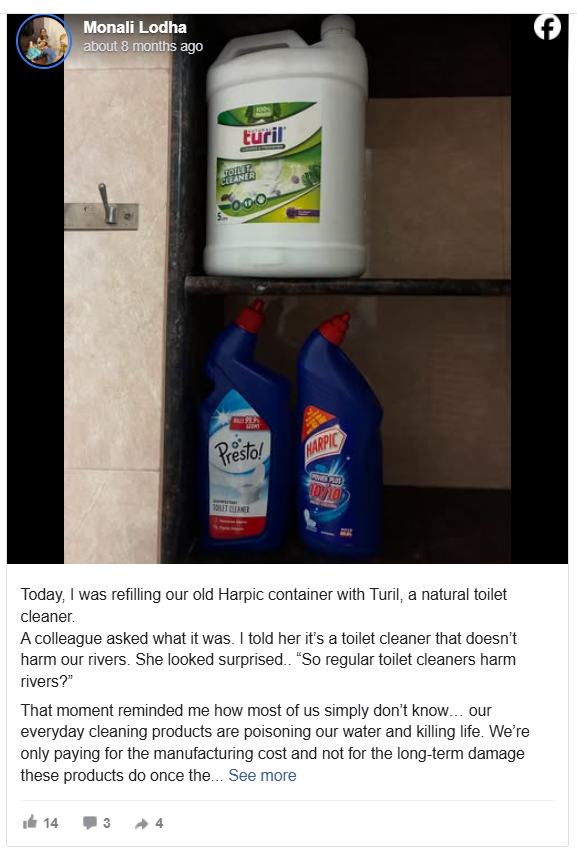
A social media post describes replacing an old Harpic bottle with Turil, a “natural” toilet cleaner, and raises concerns about whether regular toilet cleaners pollute rivers and harm human health. The post claims that widely used products such as toilet cleaners, detergents, and dishwashing liquids contain toxic chemicals that damage aquatic ecosystems and are linked to health problems, while promoting “natural” alternatives as safer.
We decided to do a fact check on this.
Fact Check
Claim1: Do conventional toilet cleaners like Harpic harm rivers and aquatic life when flushed down household drains?
Most conventional toilet cleaners like Harpic contain strong disinfectants, acids, and surfactants that can be toxic to fish and other aquatic life if they enter waterways at sufficient concentration. Laboratory studies show concentrated Harpic solutions cause severe damage to fish gills and muscles. Manufacturer labels themselves warn Harpic is “Harmful to aquatic life with long lasting effects.” However, in real homes bleach and acid are usually diluted and most rapidly react or are removed by wastewater processes. For example, sodium hypochlorite is highly toxic to fish in lab tests, but it is highly reactive, quickly breaks down to chlorine, and does not bioaccumulate. Read here.
However, in countries like India, only about 28–30% of sewage is treated, and recent studies in Delhi’s Yamuna found very high detergent/surfactant levels from untreated sewage causing persistent foam and oxygen depletion.
Therefore, the potential toxicity is real and Harpic’s label warns of it, but ordinary use volumes are low and chemicals rapidly break down in the environment.
Claim 2: Are ingredients commonly found in toilet cleaners—such as sodium hypochlorite (bleach), phosphates, SLS/SLES, quaternary ammonium compounds, fragrances, and dyes—known to pollute rivers at real-world household use levels?
In Harpic and many cleaners, bleach (mainly sodium hypochlorite) is a powerful oxidizer. It is extremely toxic to aquatic life in pure form, but it quickly degrades in water. Read here Thus, while a spill of concentrated toilet-bleach can kill fish in a small pond, trace household bleach in a city sewer is mostly consumed and diluted before reaching rivers.
Harpic Power Plus and many toilet cleaners contain concentrated hydrochloric acid (HCl), 10–12%. Strong acids can kill microbes and even corrode metals, and undiluted acid can injure fish by instant pH shock. But sewage and natural waters are well buffered, so flushed acid is rapidly neutralized to harmless salts. Still, Harpic’s label warns it “causes burns.” Users should flush and ventilate when using acid cleaners, but normal use and downstream dilution mean few lingering acid hazards.
Surfactants (SLS, SLES, non-ionic, etc.): these soap-like detergents are moderately toxic to aquatic organisms at high dose, and some break down into harmful compounds. Read here For example, certain nonyl-phenol ethoxylate surfactants are known endocrine disruptors which are no longer used by many big brands. A TERI study found foaming of the Yamuna caused by high detergent/surfactant loads in untreated sewage.
However, most common anionic surfactants like SLS/SLES are ready- or biodegradable: they dilute and split into innocuous fatty acids in soil or water. At household use levels, traces of SLS/SLES in river water are usually well below fish-kill thresholds.
Quaternary ammonium compounds (“quats”): These potent disinfectants, like benzalkonium chloride and cetyltrimethylammonium, are in some cleaners. Quats kill bacteria very effectively, but they also irritate skin/eyes and are respiratory sensitizers like “asthmagens.” Studies show chronic quat exposure can promote microbial antibiotic resistance. Quats are harmful to aquatic bacteria and algae in high doses. However, like other biocides, they are diluted in sewage.
Phosphates wash into rivers and lakes and trigger explosive algal blooms and low oxygen (eutrophication). One analysis estimated about 146,000 tonnes of phosphorus per year flow from Indian laundry detergents into waterways. Read here. This is primarily laundry/dish detergent; modern toilet cleaners, including Harpic, don’t usually use high phosphate.
Claim 3: Do these chemicals routinely pass untreated from homes into rivers, where they accumulate and kill fish, insects, or beneficial microorganisms?
It’s important to consider the fate of these chemicals. In many countries, wastewater treatment plants break down cleaning chemicals.
But in countries like India, the situation is dire: roughly 72,000 million litres of sewage are generated each day, but only ~28% are actually treated. Thus, most Harpic or detergent molecules flushed in cities directly enter drains and eventually rivers with little filtration. Read here, here and here.
Therefore, dilution and treatment do mitigate acute toxicity. Unlike accidental discharges, routine home use spreads chemicals thin over time.
Claim 4 : Is regular use of products like Harpic scientifically linked to health effects such as skin irritation, respiratory problems, or hormonal disruption?
Harpic and similar cleaners are corrosive or irritating. Labels explicitly warn of “causes skin irritation” and “serious eye damage.” A typical toilet-cleaner user might splash or rub, causing burns if not careful. These are immediate hazards. Users should always wear gloves and avoid splashes.
Volatile fumes from bleach, ammonia, or strong acids in cleaners can irritate airways. In one long-term study, women who extensively used household cleaners showed lung function decline comparable to heavy smokers. Read here. In practice, normal toilet use involves minimal inhalation of a liquid cleaner with some fumes, but precautions like ventilation and not mixing chemicals are wise.
The social-media post implies “toilet-cleaner chemicals” are hormone disruptors. Typical Harpic formulations such as acids, quats, bleach, and surfactants are not known endocrine disruptors based on regulatory bodies like EPA, EU, etc. They have identified other cleaning-related chemicals like phthalates or nonylphenol surfactants as endocrine disruptors. These are sometimes used in fragrances or older detergents. For example, fragrances labeled simply as “perfume/parfum” may hide phthalates or synthetic musks known to affect hormones.Therefore, there is no evidence that Harpic’s listed ingredients such as HCl, amine oxide, benzalkonium chloride, etc., cause hormonal effects in humans at home-use levels. In short, thedominant health risks of Harpic use are acute (burns, irritation), not chronic endocrine damage.
Claim 5: Are “natural” toilet cleaners like Turil demonstrably safer for rivers and human health compared to conventional brands, or is the difference overstated?
“Natural” brands like Turil advertise plant-derived formulas such as vinegar, citric acid, and herbal extracts. These are generally more biodegradable and have lower aquatic toxicity than synthetic chemicals. For instance, citric acid from lemon is used as a disinfectant: it is not listed as a respiratory or reproductive hazard and is considered safe for waters in typical concentrations; it has “no known aquatic toxicity.” Vinegar (acetic acid) similarly breaks down easily. Many green-cleaning guidelines even recommend citric acid or hydrogen peroxide in place of harsher agents. In that sense, Turil-type cleaners are likely less harmful to rivers: their residues won’t persist or bioaccumulate. They also avoid bleach and quats, eliminating risks of chlorine gas or antibiotic-resistant bacteria. More details can be read here.
However, “natural” does not mean completely risk-free. Concentrated vinegar or citric acid is still strongly acidic (pH ~2–3) and can irritate skin/eyes if mishandled. Such products still require caution. Importantly, marketing often overstates the contrast: a single flush of Harpic isn’t going to “kill the river” if sewage is treated, and a plant-based cleaner still needs proper use. In short, Turil likely poses lower long-term environmental risk, as its ingredients readily biodegrade, but the difference is not a magical divide—it’s a matter of relative hazard. More details can be read here.
Conclusion
Claims about toilet cleaners like Harpic and their environmental impact vary in accuracy. The real environmental effect depends on several factors, including how much the chemicals get diluted and whether wastewater goes through proper treatment. “Natural” cleaners generally use biodegradable ingredients like citric acid and plant enzymes, which break down more easily in the environment, though they still need to be used carefully.
The type of cleaning product you choose matters, but it’s just one piece of the puzzle. Other important factors include the quality of wastewater infrastructure and how products are used. In areas with limited sewage treatment, such as parts of India where most sewage goes untreated, the combined release of cleaning chemicals can contribute to water pollution problems, including the buildup of surfactants and lower oxygen levels in water bodies.
Title:Is Harpic Damaging River Ecosystems and Harming Human Health?
Fact Check By: Rashmitha DiwyanjaleeResult: Misleading
