

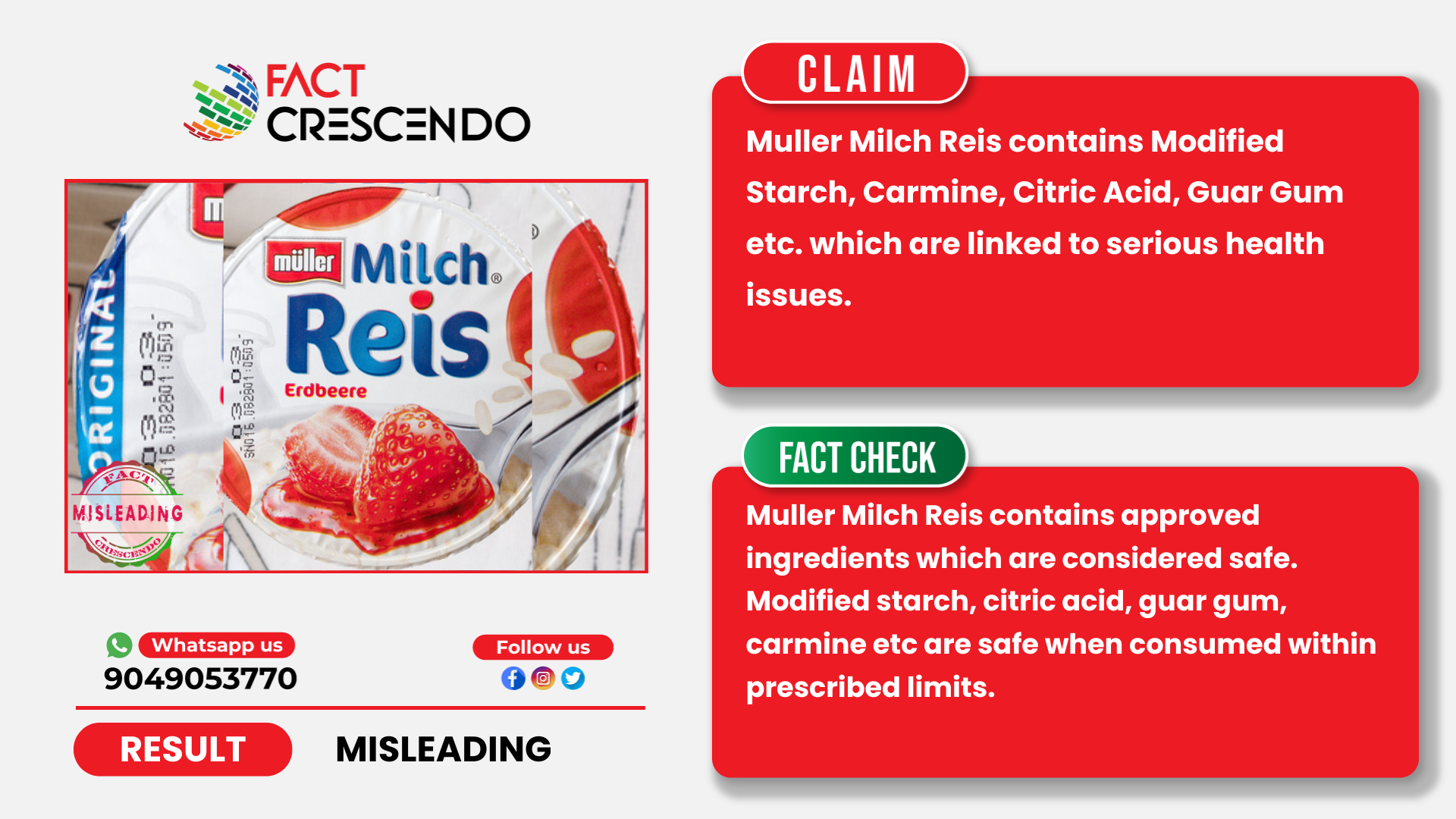
In recent posts on social media, users have raised their concern over the use of various ingredients used in Muller Milch Reis strawberry products. The claim states that the brand uses artificial ingredients like modified starch, citric acid, guar gum, carmine etc. which are related to many health issues.
However, Fact Crescendo found the claim to be misleading. All the ingredients mentioned in the post are safe for consumption when prepared with good manufacturing practices and used within the prescribed limits.
Fact Check-
Let’s check the safety of all the ingredients mentioned in the post.
Modified Starch: According to the National institute of Health, chemically modified starches are treated as food additives and are labeled as ‘modified starch’. However, starches modified only by physical or enzymatic methods are not considered additives; they are simply food ingredients, unless the process involves a starch that was already chemically modified. Chemically modified starches have many advantages. They are made from natural starch, which is easily available, renewable, biodegradable, and affordable. Chemical modification helps improve starch properties, making it suitable for different uses in the food industry. These starches can improve food texture, stability, and shelf life.
Citric Acid: Citric acid (C₆H₈O₇) is a naturally occurring compound found in plants and animals. It appears as a colorless crystal or white powder. It can be obtained from natural sources like lemon or pineapple juice, or produced through fermentation using specific fungi such as Candida or Aspergillus niger. The citric acid used in food must meet the quality and purity standards set by the Food Chemicals Codex. It is approved for use in food without any restrictions if prepared under good manufacturing practices guidelines.
Citric Acid (E330) is also listed under approved additives by Food Safety Standards in the UK.
Guar Gum: Guar gum is a fine powdered fiber created from the ground seeds of the guar plant. It is used in food products as a thickener and a binder. It is created by de-husking, then milling, and finally sorting the guar bean. It is then ground into a powder form. Guar gum can be found in soups, stews, ice cream, yogurt, and marinades. It is also used in plant-based milks such as flax, almond, coconut, soy, and hemp.
The ingredient is recognized by the U.S. FDA as generally safe for use in foods till it meets quality and purity standards laid down in the Food Chemicals Codex. It is commonly used in many food products such as baked goods, dairy items, sauces, soups, and jams to act as a thickener, stabilizer, emulsifier, or texture-improving agent. The regulation allows its use only within specified limits for different food categories to ensure consumer safety.
According to the National Institute of Health, guar gum is considered safe when used in normal amounts in food. It is generally used in very small quantities, usually less than 1% of the food product. Studies showed that at this normal level, no harmful effect from the ingredient was found. Some safety concerns were noticed during animal studies where high amounts of Guar gum was consumed (about 10-15% of the diet). At this high level, digestive problems due to excessive thickness in the gut was noticed. However, this level is far higher than what humans consume through food.
Carmine: Cochineal extract and Carmine (E120) has been approved by the US Food and Drugs Administration for use as color additive in foods. But the FDA has instructed brands to label foods and their products with the common name ‘Carmine’.
According to FDA Code of Federal Regulations, Carmine and cochineal extract must be pasteurized or treated to eliminate Salmonella. During this process, only substances that are safe and necessary for the treatment can be added. In case other substances are being added and should not be considered food additives or, if they are, must comply with established safety regulations under the law. It further says that these color additives don’t need certification because they are safe for public health. Hence, the usual certification rules don’t apply to them under the law.
The National Institute of Health report says that since 2000, the acceptable daily intake for cochineal, carminic acid and carmine (E 120) has been limited to 5 mg/kg body weight. This compound gets absorbed into human tissues, but acute, short-term, sub chronic, carcinogenicity, reproduction and developmental toxicity studies conducted in rats or mice did not show any toxicological potential. But there remain some possibilities of allergic reactions.
Conclusion: Fact Crescendo found the claim to be misleading. Muller Milch Reis contains approved ingredients which are considered safe. Modified starch, citric acid, guar gum, carmine etc are safe when consumed within prescribed limits.
Title:Misleading claims about Muller Milch Reis containing harmful ingredients going viral on social media.
Fact Check By: Siddharth SahuResult: Misleading
