

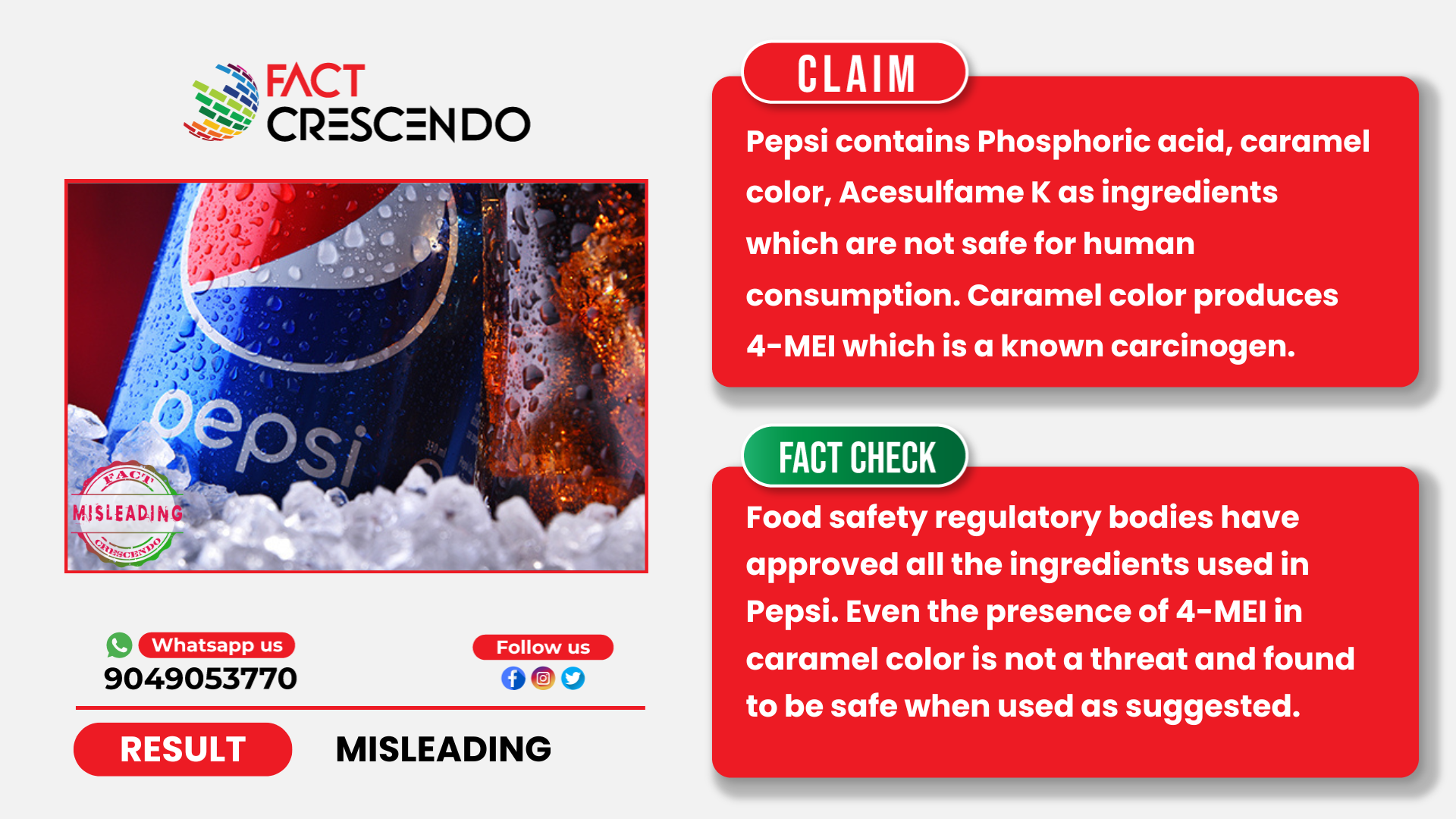
Pepsi is a globally popular carbonated soft drink introduced in 1893. It has a strong brand presence across international markets. Over the decades, it has become one of the leading beverage brands. Recently, some social media users have been claiming that Pepsi contains harmful ingredients which has raised concerns among the consumers.
However, Fact Crescendo found the claim to be misleading. All the ingredients used in Pepsi are safe for consumption, as declared by the food safety regulatory bodies.
What’s the claim?
Social media users are claiming that Pepsi contains Phosphoric acid, an industrial chemical. It also contains caramel color E150d which contains a contaminant called 4-MEI which is a carcinogen. Further, it contains artificial sweeteners like Acesulfame K which is sweeter than sugar and human bodies can’t break it down and can lead to cancer. It also contains sucralose which damages the DNA and kills the gut bacteria.
Fact Check-
Let’s check the facts of all the ingredients mentioned in the viral video.
Phosphoric Acid: Phosphoric acid is a chemical often added to foods and drinks, including soft drinks, to give them a tangy taste and help control acidity, flavor, and shelf life. The U.S. Food and Drug Administration (FDA) approved its use in foods as a flavor enhancer, pH control agent, and antimicrobial agent. It is considered safe when used as mentioned in the current regulations. Although, the concentrated form of Phosphoric acid can be irritating or harmful.
EFSA re-evaluated phosphoric acid and found no evidence of it to cause cancer or genetic damage. Phosphoric acid has low toxicity and has been already approved as a food additive in the European Union. The organization had established an acceptable daily intake (ADI) of 40 mg of phosphorus per kilogram of body weight per day. However, EFSA also pointed out that estimated dietary intake could exceed this ADI in infants and children.
Caramel Color (E150d): The scientific panel reviewed the safety of four types of caramel colours used in foods and found that they are generally safe when consumed within set limits. These colours are made by heating sugars in different ways. Based on animal studies, the panel set a combined safe intake level for all caramel colours except for E150c. Due to possible effects on the immune system, a lower limit of E150c was set by the panel. The panel clarified that key harmful substances found in caramel colours are not currently a major concern.
What is 4-MEI found in E150d: 4-methylimidazole (4-MEI) is a chemical compound that forms as a byproduct at low levels in some foods and beverages during the normal cooking process. 4-MEI may form when coffee beans are roasted and when meats are roasted or grilled. It also forms while preparing Class III and Class IV caramel color.
According to the FDA, there are no immediate or short-term health risks presented by 4-MEI at the levels expected in food. In 2007, the National Toxicology Program (NTP) issued reports summarizing the results of toxicological testing conducted on 4-MEI in rats and mice. A 2-year study in rats was inconclusive regarding carcinogenicity, but a 2-year mouse study showed an increased incidence of certain lung tumors. These NTP studies were conducted in rodents at levels of 4-MEI that far exceed current estimates of human exposure to 4-MEI from the consumption of food with or without the addition of Class III or Class IV caramel coloring.
In March 2020, a study tested whether 4-MEI affects reproduction and development in rats and found some effects at very high doses. However, these doses were much higher than what people normally consume through food.
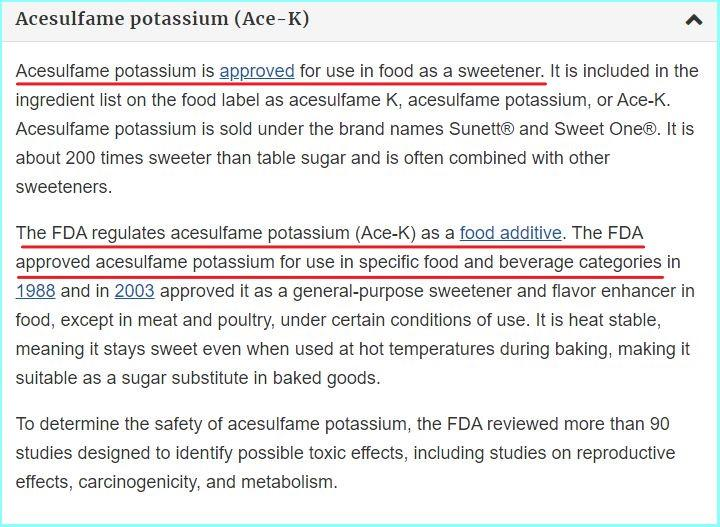
Acesulfame K: Acesulfame potassium, also known as Ace-K or E950 has been approved by FDA for use in food as a sweetener. The FDA approved acesulfame potassium (Ace-K) as a food additive in 1988 for certain foods and beverages, and in 2003, it was approved as a general sweetener and flavor enhancer. To ensure its safety, the FDA reviewed over 90 studies that looked at potential toxic effects, including its impact on reproduction, cancer risk, and metabolism.
According to another report, the FDA and National Cancer Institute (NCI) had confirmed that Ace-K is safe and that there is enough evidence to say that it does not cause cancer. In 2005, the National Toxicology Program conducted a large animal study where they gave mice acesulfame potassium, making up 3% of their diet, for over 40 weeks. This is roughly equal to a person consuming more than 1,000 cans of soft drinks daily. The study found no evidence of an increased risk of cancer in the mice.
Sucralose: Some studies show that sucralose can affect your gut by reducing good bacteria by half. Research on animals also suggests that it may cause inflammation in the body. Too much inflammation over time can lead to health problems like obesity and diabetes.
However, sucralose is approved for use in food as a sweetener. It is sold under the brand name Splenda. The FDA approved sucralose for use in 15 food categories in 1998 and for use as a general-purpose sweetener for foods in 1999, under certain conditions of use. To determine the safety of sucralose, the FDA reviewed more than 110 studies designed to identify possible toxic effects, including studies on the reproductive and nervous systems, carcinogenicity, and metabolism. The FDA also reviewed human clinical trials to address metabolism and effects on patients with diabetes.
Conclusion:
Fact Crescendo found the claim to be misleading. Food safety regulatory bodies have approved all the ingredients used in Pepsi. Even the presence of 4-MEI in caramel color is not a threat and found to be safe when used as suggested.
Title:Ingredients in Pepsi are not safe for human consumption? No. The viral claim is misleading.
Fact Check By: Siddharth SahuResult: Misleading
