

A viral claim circulating on Facebook, Instagram and X that Walmart now accepts Ethereum (ETH) payments in its physical stores. However, this claim overstates what Walmart has actually rolled out and is missing context.
Social Media Posts
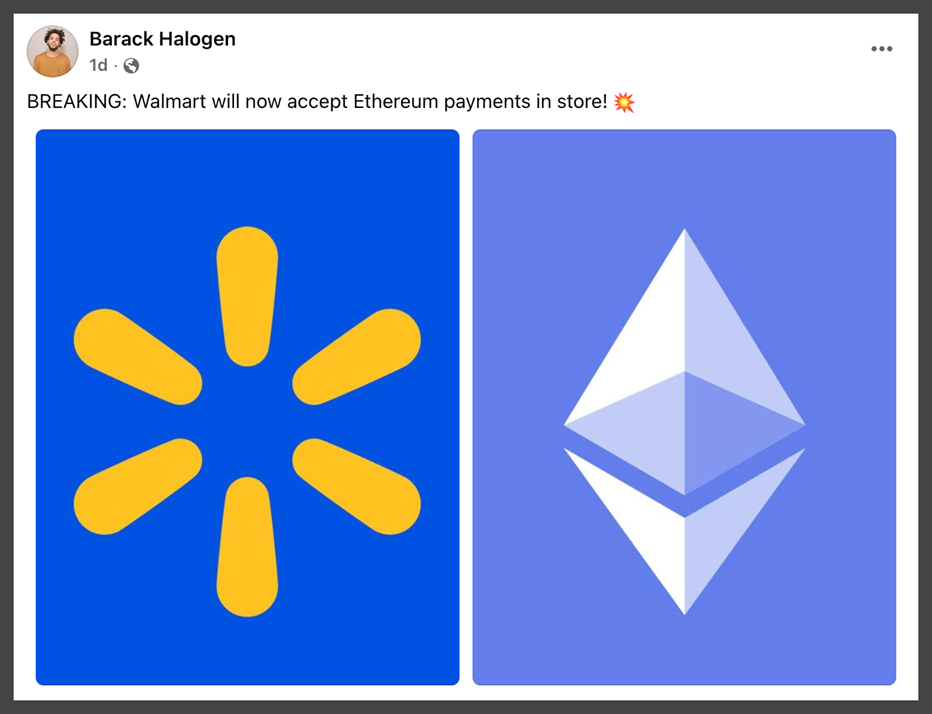
Multiple posts on social media claimed that Walmart now accepts Ethereum payments.

Fact Check
What Walmart Actually Announced
According to reporting by Yahoo Finance, Walmart’s fintech subsidiary, OnePay, has introduced cryptocurrency trading and custody services for Bitcoin and Ethereum within its mobile app, allowing users to buy, hold, and sell these assets inside the app.
Additional coverage from Binance explains that these features are designed to integrate crypto holdings into OnePay’s broader digital finance ecosystem, which includes payments, cash balances, and linked cards, rather than changing how Walmart’s in-store checkout systems operate.
Actual Payment Flow
Many social posts describe this development as Walmart “accepting Ethereum in store.” The payment flow involves converting cryptocurrency into U.S. dollars before payment is made to Walmart, rather than as a direct on-chain Ethereum transaction at the register. As Nasdaq explains, when major retailers are described as “accepting crypto,” this typically refers to backend conversion systems where the merchant ultimately receives fiat currency, not cryptocurrency.
There is no evidence that Walmart’s point-of-sale terminals natively process Ethereum transactions, such as scanning a wallet QR code and settling payment on the Ethereum blockchain directly to a Walmart-controlled wallet. Reporting from MEXC notes that no documentation shows Walmart POS systems generating Ethereum addresses or handling on-chain settlement.
How Customers Can Spend Value Originating From Ethereum
Under the OnePay system, a customer who holds Ethereum inside the app can sell that ETH and instantly convert it into a U.S. dollar balance. That dollar balance can then be used for Walmart purchases in-store or online, making it appear as though the customer is “paying with Ethereum.” Cryptorank describes this as a crypto-to-fiat bridge embedded into Walmart’s payments ecosystem, rather than true crypto acceptance at checkout
Functionally, this means Ethereum is never transferred to Walmart. The crypto is sold within OnePay first, and only U.S. dollars are passed through Walmart’s payment rails, according to reporting by SAHM Capital.
To put it simply, there is currently no Walmart app or Walmart.com option like “Pay with Ethereum.”
How In-Store Payments Actually Work
Once Ethereum has been converted to dollars inside OnePay, the customer pays at checkout using existing OnePay payment methods, such as OnePay Cash, Scan-to-Pay features, or linked debit cards. According to OnePay’s own help documentation, payments at the register are drawn from a fiat balance or card, not from a live crypto transaction
CoinLaw similarly reports that OnePay allows users to buy, hold, and sell Bitcoin and Ether, then instantly convert those holdings to dollars for use at Walmart registers or online checkout, reinforcing that the crypto step happens before the point of sale
Additional reporting by 99 Bitcoins and Our Crypto Talk confirms that after conversion, funds function like regular OnePay Cash and are spent as fiat currency rather than cryptocurrency.
Conclusion
The claim that “Walmart now accepts Ethereum payments in store” is missing context. Walmart’s OnePay app allows users to convert ETH into dollars, which can then be used for purchases. However, Walmart itself only receives U.S. dollars, not cryptocurrency. Customers cannot pay directly with Ethereum at checkout; ETH must first be sold within the OnePay app and converted into U.S. dollars before payment is made.

Title:Does Walmart Now Accept Ethereum Payments In-Store?
Fact Check By: Pranpreeya PResult: Missing Context
