

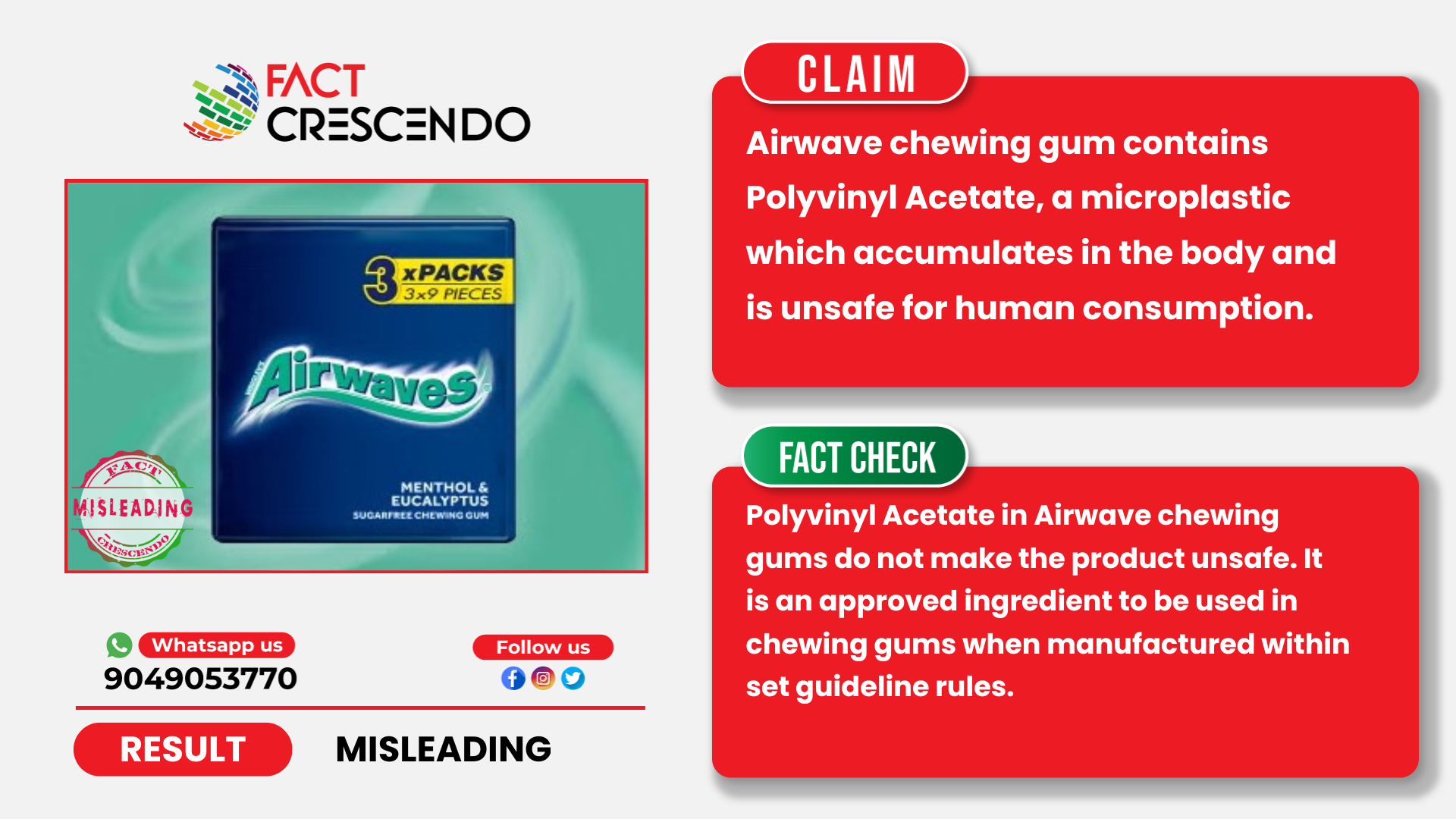
Airwaves chewing gum, a product of the Wrigley Company, was first introduced in the United Kingdom in 1997. The brand was launched as a functional gum, specifically designed to help clear the head and nasal passages with its intense menthol and eucalyptus flavor similar to the effect of cough drops.
But now many consumers have raised their concerns over the use of Polyvinyl Acetate as an ingredient in the product. Many claims on social media suggest that Polyvinyl Acetate is a kind of microplastic which keeps accumulating in the body and disrupts hormones. This resulted in the recall of Airwave Chewing Gums from the market.
Fact Check-
First, we checked for the list of ingredients used in the Airwave Chewing Gums. As per the information available on the website, the product contains many ingredients like sweeteners sorbitol, isomalt, maltitol syrup, aspartame, acesulfame k, mannitol, gum base, glazing agent calcium carbonate, flavourings, thickener gum arabic, emulsifier soybean lecithin etc.
In many products, the term Gum Base is used for the ingredient Polyvinyl Acetate. This makes it clear that Airwave chewing gums contain Polyvinyl acetate.
What is Polyvinyl Acetate?
Polyvinyl Acetate (PVAc) is a synthetic polymer used as a chewing gum base and as an edible coating for fruits, vegetables (like peppers), and cheese to extend shelf life and add gloss. It acts as a binder, sealant, and film-former, enhancing food quality and presentation without toxicity, and is also found in food packaging materials.
Safety of Polyvinyl Acetate:
Agency for Toxic Substances and Disease Registry (ATSDR) stated that Vinyl acetate can get into the body in several ways like by breathing air that contains it, by eating or drinking food or water that has it. Animal studies have shown that when vinyl acetate is inhaled or swallowed, it enters the body very quickly. Vinyl acetate and its breakdown products spread quickly and also get removed quickly. The body breaks it down fast, and most of it is breathed out within a few days as carbon dioxide. Small amounts leave the body through urine and stool as broken-down substances.
Short-term exposure to vinyl acetate in air can irritate the eyes, nose, and throat. Some people experienced throat irritation after breathing low levels for a few minutes. Inhaling higher levels caused coughing and eye irritation. The workers who are exposed to about 10 ppm over many years did not show health problems. In animals, breathing high levels causes irritation and lung damage, and studies suggest possible effects on the immune and nervous systems. Vinyl acetate has not been shown to cause cancer in humans, but it caused nasal tumors in rats when they were exposed to very high levels of the product (600 ppm).
Another report stated that the ingredient is used in many medicines as a coating that protects drugs in the stomach. As polyvinyl acetate is flexible and has low toxicity, it is commonly used in chewing gum and to coat fruits and vegetables.
The safety of Polyvinyl Acetate has been assessed by the Cosmetic Ingredient Review (CIR) Expert Panel. The CIR Expert Panel evaluated the scientific data and concluded that Polyvinyl Acetate was safe as a cosmetic ingredient. The Panel noted that because of the large size of polymer molecules, they do not penetrate the skin and exposure is very low. Although available data did not completely identify all possible trace materials that may be found in Polyvinyl Acetate, the CIR Expert Panel concluded that the concentrations of arsenic and heavy metals were insignificant and presented no safety concern.
The FDA had approved the use of Polyvinyl Acetate as a chewing gum base under certain rules. The rule allows polyvinyl acetate with a minimum molecular weight of 2,000 to be used as part of the gum base because it is considered safe when used as intended. It must meet quality and safety standards and be used only in the amount needed to perform its function.
Conclusion:
Fact Crescendo found the claim to be misleading. Polyvinyl acetate is an approved ingredient to be used in chewing gums when manufactured within set guideline rules. Its presence in Airwave Chewing Gum does not make the product unsafe for consumption.
Title:Airwave Chewing Gum contains microplastics and have been recalled from the market? Know the facts.
Fact Check By: Siddharth SahuResult: Misleading
