

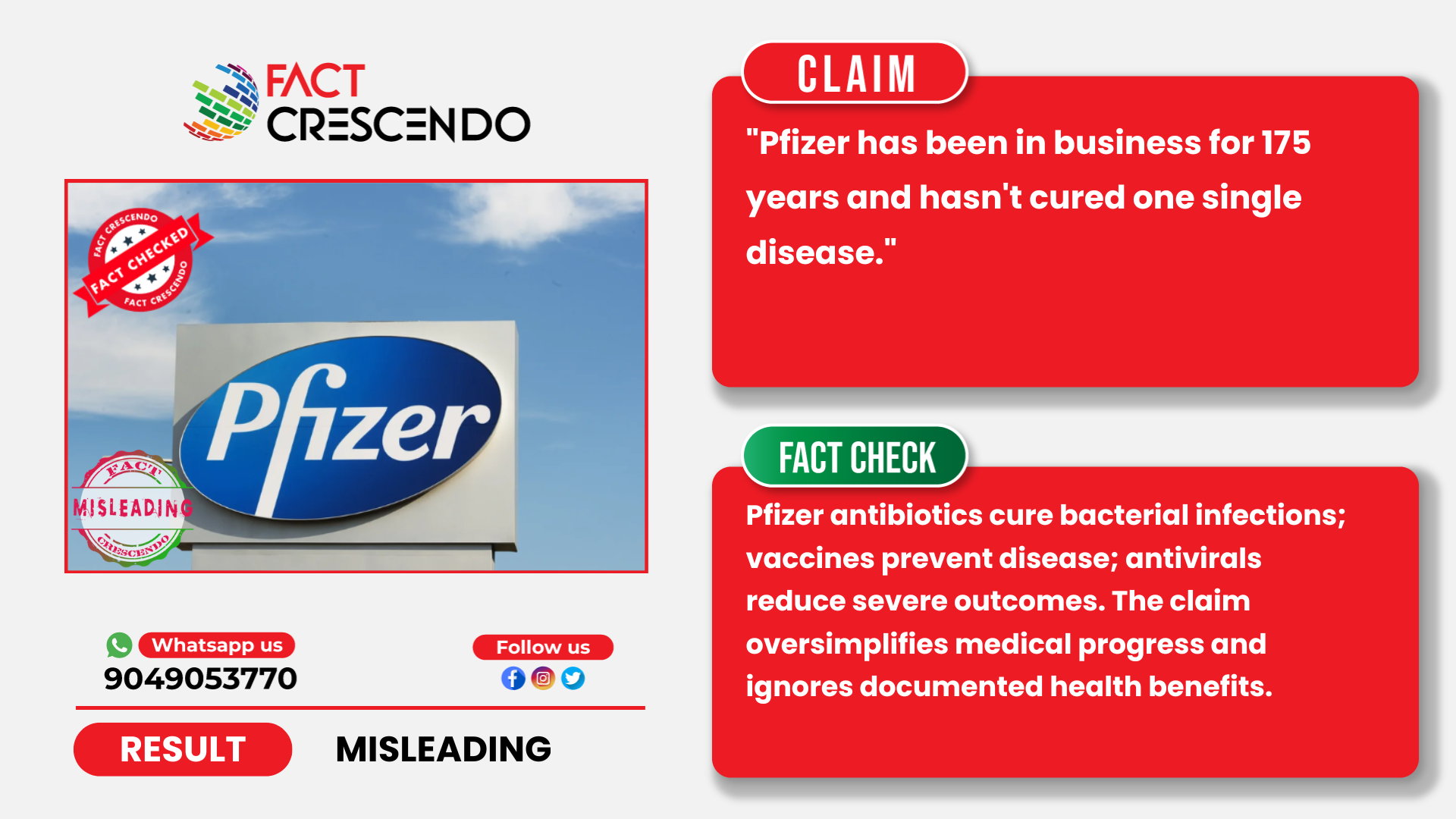
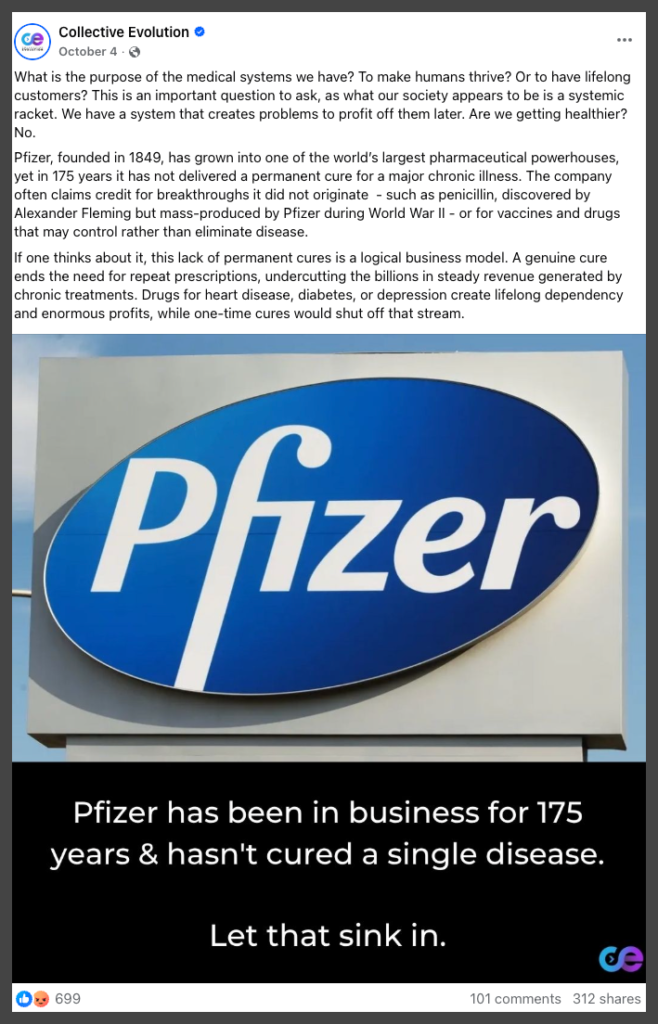
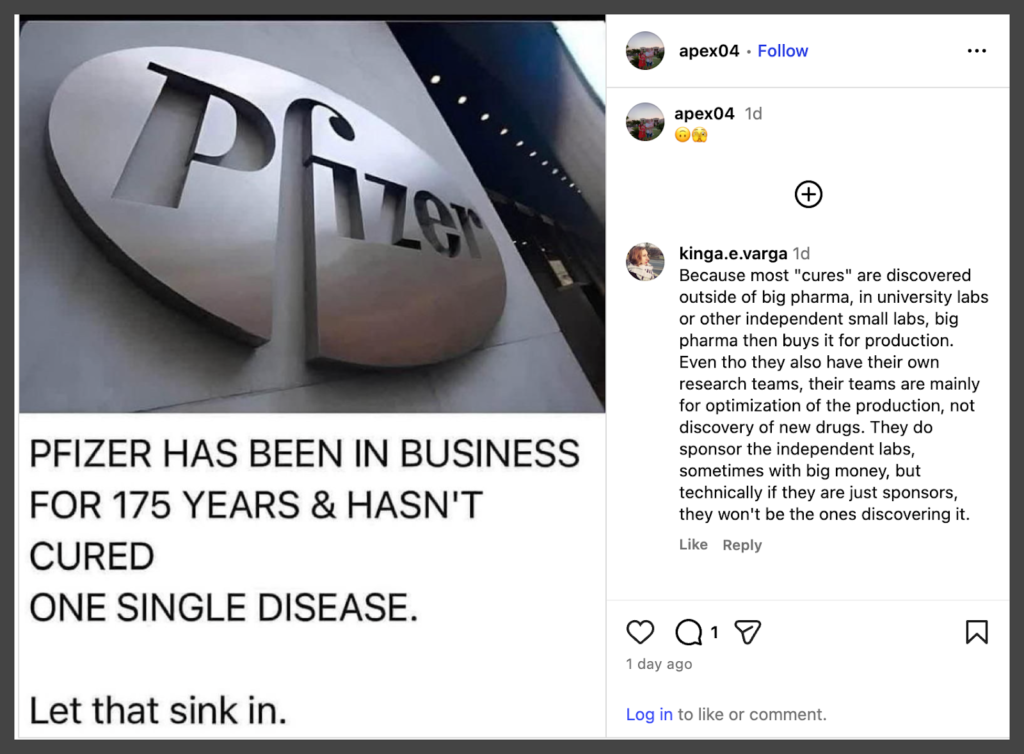
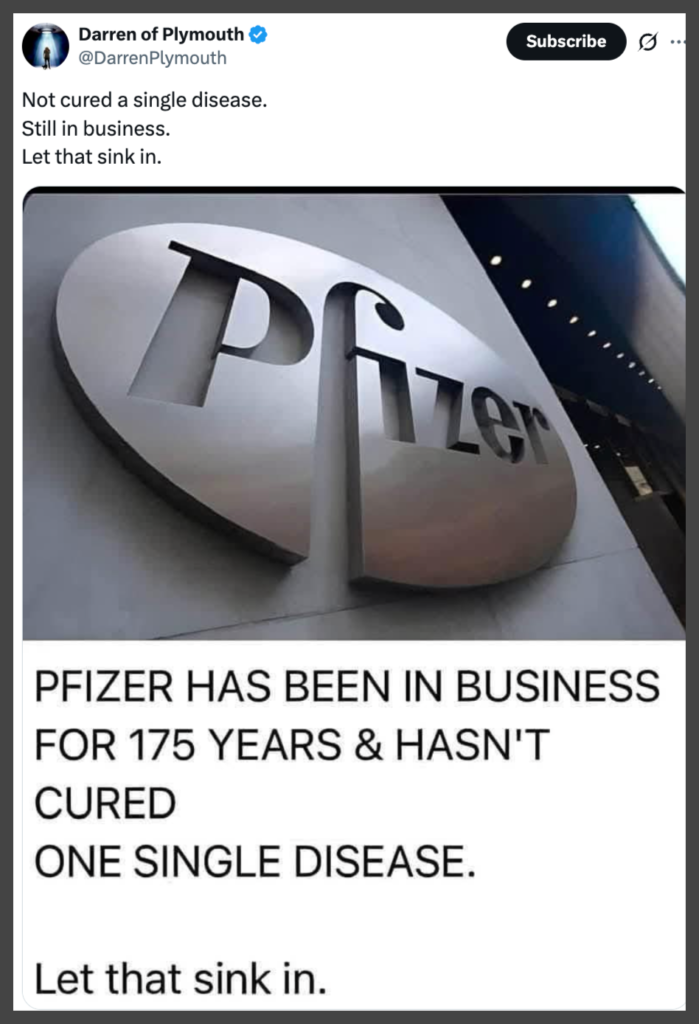
A claim circulating on social media implying that Pfizer’s long history proves it has never produced medicines that cure disease. This type of statement is often shared as a slogan on platforms like Facebook and X. However, we found this claim to be misleading.
Social Media Posts
Posts typically present the claim as a standalone sentence: “PFIZER HAS BEEN IN BUSINESS FOR 175 YEARS & HASN’T CURED ONE SINGLE DISEASE.” These posts have been spreading on Facebook, Instagram, and X recently.
Fact Check
Why “hasn’t cured one single disease” is misleading
The U.S. CDC defines eradication as the permanent worldwide elimination of a disease-causing agent in nature, and elimination as the absence of disease or infection in a specific geographic area (though prevention efforts must continue). These distinctions show that “cure” is not the only, or even the most important, way to measure medical progress.
Multiple Pfizer products have been central to curing individual infections and controlling diseases at population level. Against this background, evaluating Pfizer’s impact requires looking at how its medicines are actually used in clinical practice.
Penicillin and Other Antibiotics
A direct problem with the claim is that many bacterial infections can be cured with antibiotics when properly diagnosed and treated. Penicillin-class antibiotics are a clear example. The American Chemical Society‘s historical review documents that during World War II, Pfizer successfully mass-produced penicillin using deep-tank fermentation, making the drug widely available.
Pfizer currently markets penicillin products, including BICILLIN L-A (penicillin G benzathine) and PFIZERPEN (penicillin G potassium). This is important because penicillin G (including long-acting forms) is the first-line recommended treatment for syphilis according to U.S. CDC guidelines, and the CDC notes it has been used effectively to resolve infections and prevent serious complications.
In other words, the claim that Pfizer has “not cured one single disease” overlooks the fact that antibiotics, including penicillin-class drugs that Pfizer has produced and continues to sell, are routinely used to cure bacterial infections in individual patients.
Clarifying the meaning of “cure” in the context of syphilis
The term “cure” in this article means clinical cure at the individual patient level, successfully eliminating the infection with proper treatment, not wiping out the disease worldwide. The U.S. CDC confirms that syphilis is a bacterial infection and penicillin G is the recommended first-line treatment that effectively resolves infection in treated patients. However, CDC guidelines also note that treatment depends on the stage of the disease: some patients, especially those with late or latent syphilis, may need longer treatment courses or repeat doses, plus follow-up tests to confirm the infection is cleared. In short, penicillin treatment is highly effective, but outcomes can vary depending on the patient’s condition and stage of disease. (Source)
Historical and clinical context for penicillin effectiveness
Penicillin’s effectiveness against syphilis is supported by decades of clinical use and its status as the recommended treatment in medical guidelines worldwide. Penicillin G has been the go-to treatment for syphilis for over fifty years, and doctors continue to rely on it because clinical experience consistently shows it clears the infection when given correctly. While Pfizer did not invent penicillin, that credit goes to Alexander Fleming, historical records show that Pfizer was crucial during World War II in developing methods to mass-produce penicillin using deep-tank fermentation, which made the antibiotic widely available for treating bacterial infections. (Source)
Vaccines and Disease Prevention
It is worth noting that prevention plays a distinct role in addressing disease. Vaccines work by helping prevent infection or reduce disease severity, and vaccination programs at scale can lower transmission rates and decrease the incidence of severe cases. Pfizer’s vaccine portfolio includes pneumococcal vaccines (the Prevnar series) and COVID-19 vaccines.
For pneumococcal disease, CDC explains that Prevnar 20 (PCV20) protects against multiple types of pneumococcal bacteria and is part of pneumococcal vaccination options used to prevent serious pneumococcal infections. The U.S. FDA’s product page for Prevnar 20 describes its indications as active immunization for the prevention of invasive pneumococcal disease caused by listed serotypes (and other prevention indications depending on age group). This is not a “cure” after infection, but rather a preventive approach used in modern medicine to reduce the risk of severe disease and lower disease burden at the population level.
For COVID-19, the Pfizer-BioNTech vaccine (Comirnaty / Pfizer-BioNTech formulations) is explicitly described in FDA-authorized labeling materials as having been shown to prevent COVID-19, reflecting the intended preventive role of vaccination. (Source) Prevention is a different type of medical outcome than curing an existing case.
Pfizer’s Antivirals and Other Medicines
Some diseases are not typically described as “curable” in everyday clinical practice because outcomes focus on reducing severity, complications, and death risk. A relevant example is Paxlovid for COVID-19 treatment in higher-risk patients. In a U.S. FDA press announcement about approval, the agency stated that Paxlovid significantly reduced the proportion of people with COVID-19–related hospitalization or death compared with placebo in the clinical trial data it reviewed. This does not mean Paxlovid “eradicates COVID-19,” but it is a measurable, clinically important benefit that contradicts the claim’s insinuation of zero real impact.
Conclusion
The claim that “Pfizer hasn’t cured one single disease” is misleading because it confuses different ways medicine helps people and overlooks documented successes. Pfizer’s antibiotics, especially penicillin-based medications, have cured many individual cases of bacterial infections such as syphilis. Meanwhile, its vaccines and antivirals have prevented diseases or lessened their severity for both individuals and entire populations. The statement oversimplifies how modern medicine addresses disease and ignores well-documented, measurable benefits demonstrated in clinical use and public health outcomes.

Title:Claim That Pfizer “Hasn’t Cured One Single Disease” Is Misleading
Fact Check By: Cielito WangResult: Misleading
