


IRN-Bru is a carbonated soft drink which originated from Scotland in early 1901. It is known for its bright orange colour which makes it one of the most popular drinks world-wide. However, social media users were found raising concerns over the ingredients used in this drink.
In a viral video, a user can be heard saying that IRN-BRU contains many ingredients like Ponceau 4R, Sunset Yellow Color, Sodium Benzoate, Aspartame and Acesulfame K which are toxic and can have adverse effects on human health. The claim also suggested that some of these ingredients are carcinogens as well.
Fact Check-
Let’s check the facts about each of the ingredients mentioned in the viral video.
Ponceau 4R: Ponceau 4R (E124) is a synthetic strawberry-red azo dye used as a food coloring for beverages, desserts, and confectionery etc.
In 2009, the European Food Safety Authority (EFSA) reevaluated Ponceau 4R to check its safety as a food additive. The panel reviewed animal studies and existing data and decided to lower its Acceptable Daily Intake (ADI) level from 0 to 4mg per kilogram of body weight per day to 0.7 mg/kg body weight per day. The panel suggested that over consuming products containing this particular ingredient may have some effects on children and sometimes adults.
Ponceau 4R is not approved by the U.S. Food and Drug Administration (FDA) for use as a food additive in the United States, and it is not on the FDA’s list of permitted food color additives.
Sunset Yellow Color: Sunset Yellow Color also known as Yellow 6 is an orange-yellow dye that is used in candy, sauces, baked goods and preserved fruits. The European Food Safety Authority (EFSA) has set a new Acceptable Daily Intake (ADI) of 4 mg per kg of body weight per day for the food colouring Sunset Yellow. Previously, in 2009, EFSA had set a temporary ADI of 1 mg/kg due to limited data and recommended further studies. With new scientific data now available, EFSA has increased the ADI, confirming Sunset Yellow’s safety at the new updated level.
Sodium Benzoate: Sodium benzoate is a chemical made by mixing benzoic acid with substances like baking soda or sodium hydroxide. It does not occur naturally. According to the Code of Federal Regulations, it is generally safe when used according to good manufacturing practices, with a maximum limit of 0.1% in food. The FDA has not confirmed its safety for other uses.
The European Food Safety Authority (EFSA) evaluated a study from Southampton University that suggested certain food additives, including artificial colors and sodium benzoate, might be linked to hyperactivity in children. EFSA reviewed the study and found that while some children may be sensitive to these additives, the overall evidence was not strong enough to confirm a direct link to hyperactivity. Based on this, EFSA did not change the safety limits for these additives but recommended further research.
Does Sodium benzoate react with Citric acid to form Benzene in soft drinks which is a carcinogen?
Cancer Association of South Africa (CANSA) conducted a study to determine whether benzene could be formed in Vitamin C-containing soft drinks that also contained the preservative Sodium Benzoate. Samples from various brands were purchased and tested at an independent laboratory. The results showed that none of the tested samples contained benzene, confirming their safety for consumption. However, consumers are advised to check product labels for Sodium Benzoate and make choices.
According to another study, benzene which is a cancer causing chemical, forms in drinks that contain benzoate salt and ascorbic acid (Vitamin C) or erythorbic acid. It was found that light and head speed up the reaction, while sugar and EDTA helps prevent it. During the study, 199 soft drinks were tested and it was found that most of them had little or no benzene in it. Some drinks had more than the safe limit (5 ng/g), so manufacturers changed their formulas. After reformulation, benzene levels dropped to safe amounts (0–1.1 ng/g) or were no longer detectable.
Fact Crescendo contacted former Project Associate-2 of CSIR-Indian Institute of Chemical Technology, Hyderabad. We were told that sodium benzoate, a widely used food preservative, undergoes a double displacement reaction with citric acid, leading to the formation of benzoic acid and sodium citrate. While concerns exist about benzene formation, the likelihood is low under normal food processing and digestion conditions, as its formation requires complex reaction mechanisms, catalysts like copper or zinc, and specific environmental factors like UV exposure.
Aspartame: Aspartame is a low-calorie sweetener which tastes sweet but does not contain any natural sugars and its calorie level is much less than sugar. It is 200 times sweeter than sugar that is why it is used in very less quantity. It is an artificial substance and made of two naturally occurring amino acids called aspartic acid and phenylalanine. These two amino acids are found in various foods and in the human body as well.
According to the World Health Organization (WHO), the International Agency for Research on
Cancer (IARC) conducted a study and classified Aspartame as possibly carcinogenic to humans
(Group 2B) based on limited evidence for cancer in humans. Group 2B category means possibly
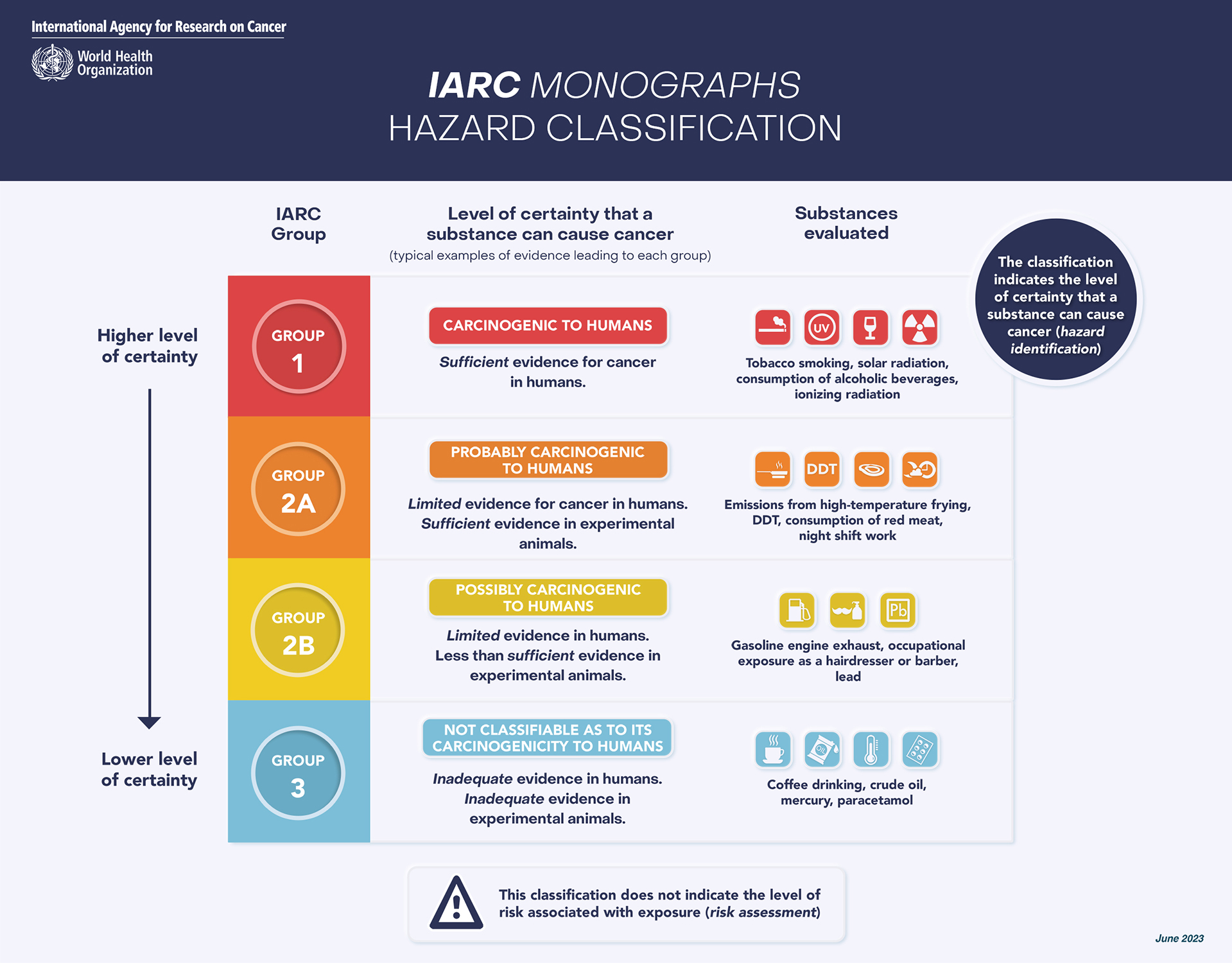
carcinogenic to humans. Gasoline engine exhaust, occupational exposure as hair dresser or
barber etc falls under this classification.
JECFA had also concluded that there was no convincing evidence from experimental animal or
human data that aspartame has adverse effects after ingestion. JECFA confirmed that
aspartame is safe to consume within the daily limit of 0–40 mg per kilogram of body weight.
That means, a 70 kg adult would need to drink more than 9–14 cans of diet soda in a day to go
over the limit, as long as they don’t get aspartame from other foods.
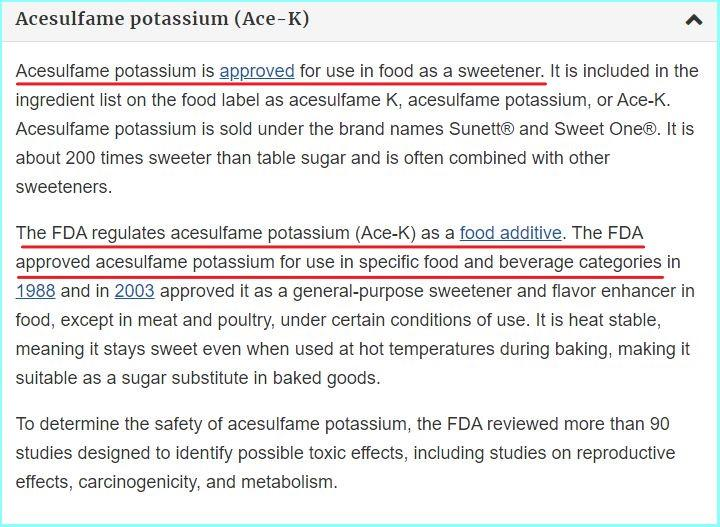
Acesulfame K: Acesulfame potassium, also known as Ace-K or E950 has been approved by FDA for use in food as a sweetener. The FDA approved acesulfame potassium (Ace-K) as a food additive in 1988 for certain foods and beverages, and in 2003, it was approved as a general sweetener and flavor enhancer. To ensure its safety, the FDA reviewed over 90 studies that looked at potential toxic effects, including its impact on reproduction, cancer risk, and metabolism.
According to another report, the FDA and National Cancer Institute (NCI) had confirmed that Ace-K is safe and that there is enough evidence to say that it does not cause cancer or any other adverse health issues. In 2005, the National Toxicology Program conducted a large animal study where they gave mice acesulfame potassium, making up 3% of their diet, for over 40 weeks. This is roughly equal to a person consuming more than 1,000 cans of soft drinks daily. The study found no evidence of an increased risk of cancer in the mice.
Conclusion:
Fact Crescendo found the claim to be misleading. Ponceau 4R, Sunset Yellow Color, Sodium Benzoate, Aspartame and Acesulfame K in IRN-BRU does not make it toxic. These ingredients are approved ones and are safe when consumed within the prescribed limits.
Title:Is IRN-BRU made with toxic ingredients and not fit for human consumption? Check the facts.
Fact Check By: Siddharth SahuResult: Misleading
