

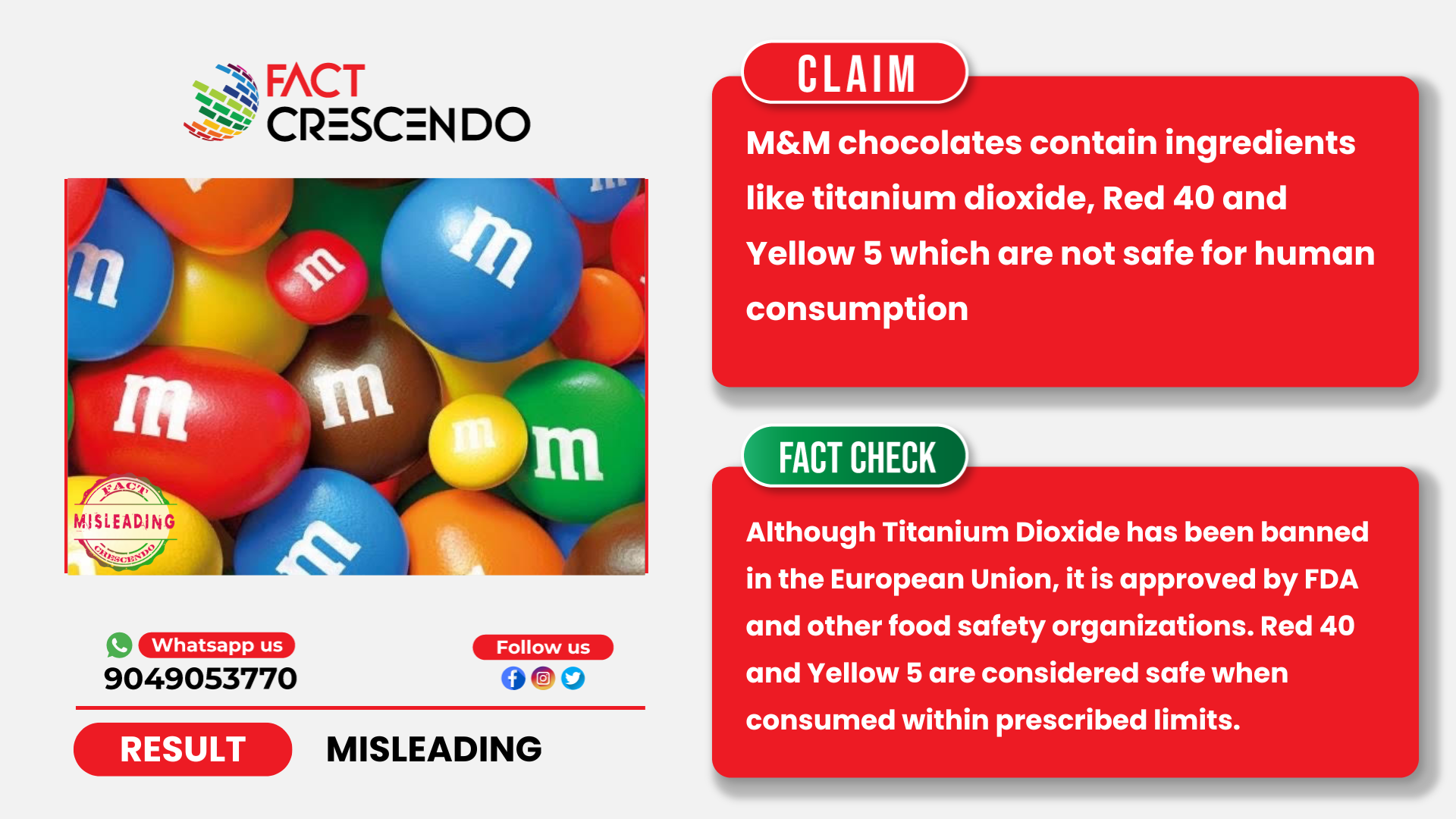
M&M’s is a popular chocolate candy brand known for its small, multi-colored chocolates. It was first introduced in the 1940s and is now widely sold across many countries. Originally, it came in brown colors but later in the 1960s new color chocolates were introduced.
Currently, social media users are pointing out that M&M uses harmful ingredients like Titanium Dioxide, Red 40, Yellow 5 and other artificial dyes which are linked to hyperactivity and hormone disruption.
However, Fact Crescendo found the claim to be misleading. Titanium Dioxide, Red 40 and Yellow 5 are approved ingredients in food. So, the presence of these ingredients in M&M do not make the product harmful.
Fact Check-
Let’s check the safety of each of the ingredients mentioned in the viral claim.
Titanium Dioxide:
Titanium Dioxide (TiO2) is a naturally occurring inorganic material that is mined from the earth and then processed and refined before it is used. It exists as a white and powdery solid substance. It is used as a white pigment for paints, in the food industry as a coloring agent, in sunscreens and cosmetics. It is also used by pharmaceutical companies for manufacturing gelatin capsules, tablet coatings and syrups.
During our research, we found that The European Food Safety Authority (EFSA) reviewed scientific evidence and found that titanium dioxide (TiO₂) particles may cause genotoxicity (damage to DNA). Due to this concern, EFSA no longer considers titanium dioxide (E171) safe as a food additive and cannot establish a safe daily intake. However, this evaluation applies only to its use in food and not to other applications.
According to the National Institute of Health, titanium dioxide is widely used in the food industry as an additive to enhance whiteness and texture. It is also found in oral medicines and is considered safe and non-toxic in small amounts. However, despite its common use in food and medicine, there is limited information on how tiny TiO₂ particles affect the body or where they go after ingestion.
On 24 November 2023, World Health Organization (WHO) and the Food and Agriculture Organization (FAO) Joint Expert Committee on Food Additives (JECFA) released an assessment of the health impacts of titanium dioxide. According to the report, TiO₂ is poorly absorbed in the gastrointestinal tract. JECFA found no evidence of carcinogenic, reproductive, or developmental toxicity effects from long-term exposure to TiO₂.
We found that the US Food and Drugs Administration (FDA) has allowed the use of titanium dioxide as a color additive in foods according to the specifications and conditions. According to FDA regulations the quantity of titanium dioxide should not exceed 1% by weight of the food. You can read the details here.
Red 40:
Red 40 is a synthetic dye that’s used in a variety of foods. The full name of this dye is FD and C red no. 40. It’s considered a color additive. Red no. 40 consists of a chemical compound called Allura red AC.
The European Food Safety Authority (EFSA) reviewed the safety of Allura Red AC (E 129), a food colouring allowed in the EU, and confirmed it is safe within the established acceptable daily intake (ADI) of 0-7 mg/kg body weight. While a recent study suggested it might cause DNA damage in mice at high doses, long-term studies showed no evidence of cancer, even at doses far exceeding typical human consumption. Other genetic tests and studies on its breakdown products also indicated no significant harm. EFSA concluded that the observed DNA effects are unlikely to lead to cancer, reaffirming Allura Red AC’s safety when used as a food additive.
FDA has permitted the use of Red 40 in cereals, beverages, gelatins, puddings, dairy products and confections.
Yellow 5:
The EFSA reviewed the safety of Yellow 5, also known as Tartrazine is a yellow food dye used in many products. Older studies showed that only a tiny amount of Tartrazine is absorbed by the body, while most of it is broken down by gut bacteria and leaves the body in urine. An acceptable daily intake (ADI) of 7.5 mg per kg of body weight was set many years ago, but the studies used were not detailed enough or focused on mixtures of dyes instead of just Tartrazine. Because of this, EFSA advised for more research to fully understand if Tartrazine is safe and if the ADI needs to be updated.
Conclusion:
Fact Crescendo found the claim to be misleading. Titanium Dioxide, Red 40 and Yellow 5 are approved ingredients in food. So, the presence of these ingredients in M&M do not make the product harmful.
Title:M&M is safe to consume. The claim is based on complete facts.
Fact Check By: Drabanti GhoshResult: Misleading
