

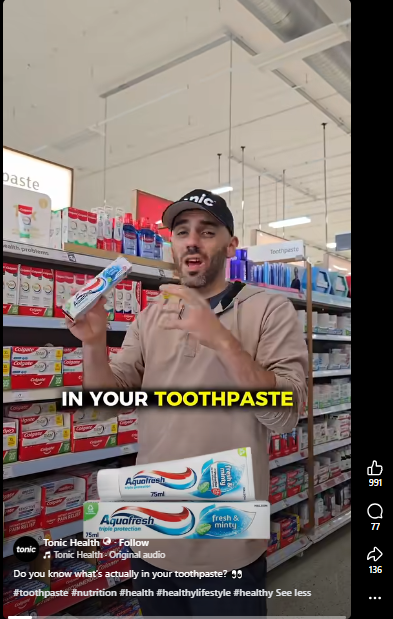
Claims about harmful chemicals in popular toothpaste brands, especially Aquafresh, have spread across social media. Posts allege the product contains “petroleum derivatives” and other “toxic ingredients.” This fact-check examines the accuracy of those claims.
Social Media Posts
A viral social media post is raising alarm about common toothpaste brands—especially Aquafresh, claiming they contain “petroleum derivatives,” “harmful chemicals,” and ingredients that “absorb into the body.” The post also promotes a ‘natural alternative’ called Biomed. This fact-check evaluates those claims.
Fact Check
Does Aquafresh toothpaste actually contain petroleum-derived or harmful chemicals such as Sodium Lauryl Sulfate (SLS), PEG-6/PEG-8, saccharin, and carrageenan?
The viral post claims Aquafresh toothpaste is full of “petroleum derivatives” and harmful additives (SLS, PEGs, saccharin, carrageenan) that soak into the body. In fact, Aquafresh’s official ingredients list confirms those same ingredients appear as inactive ingredients. For example, Aquafresh’s Cavity Protection toothpaste lists water, hydrated silica, sorbitol, glycerin, sodium lauryl sulfate (SLS), xanthan gum, flavor, titanium dioxide, PEG-8, sodium saccharin, carrageenan, and dyes (red 30, blue 1). So yes, Aquafresh contains SLS, PEG-8, saccharin and carrageenan – common additives in many toothpastes. (Different Aquafresh variants may use PEG-6 or other similar glycols, but the brand lists PEG-8 on this US product.)
Are ingredients like SLS, PEGs, saccharin, and carrageenan scientifically proven to be unsafe in toothpaste formulations?
The amounts and uses of these ingredients are very low, and none are banned or classified as poisonous by health agencies.
Sodium Lauryl Sulfate (SLS) – a surfactant/detergent that makes toothpaste foam. It is safe in toothpaste at usual dilutions. A recent review notes that SLS can help plaque control and breath freshness, though it may irritate sensitive mouths (e.g. canker sores) in some people. In other words, high concentrations or prolonged skin contact can cause mild irritation, but under normal brushing it is well tolerated. Global regulators (FDA, EMA) allow SLS in oral care, and dentist guidelines note only that sensitive users might prefer an SLS-free paste to avoid occasional mouth irritation. More details can be read here
Polyethylene Glycols (PEGs 6 and 8) – these are polymers derived from ethylene (a petroleum byproduct) used as humectants/thickeners. Chemically they originate from petroleum, but this has no bearing on safety. Cosmetic-science panels (CIR) have evaluated PEG-6 and PEG-8 and found them safe in rinse-off products. In fact, the CIR review concluded PEG-6 and PEG-8 “were considered safe for use in cosmetic formulations under present conditions” . They are used in minuscule amounts in toothpaste (typically well under 1%). No credible evidence shows that PEGs at these levels cause harm. (For perspective, PEG compounds are also used in many foods, drugs and beauty products with no toxicity at normal doses.)More details can be read here
Saccharin – a non-sugar sweetener. Decades ago, high doses of saccharin in lab animals raised cancer concerns, but modern reviews have reversed that. Both the FDA and European bodies (EFSA) re-evaluated saccharin and found no cancer risk at ordinary levels. EFSA set an acceptable daily intake (ADI) of 9 mg/kg body weight (far above any trace amount from brushing) and expressly
concluded saccharin is safe at typical exposures. In other words, using saccharin-sweetened toothpaste adds only tiny amounts of saccharin to one’s diet, well under safety limits.
Carrageenan – a thickener extracted from seaweed. It is approved as a food additive (E407) in many countries and widely used in foods (dairy, non-dairy milks, etc.) and toothpastes. Claims that carrageenan causes inflammation to come from studies of degraded forms (poligeenan) in lab animals, not the food-grade form. Dental and regulatory sources say the use of carrageenan in toothpaste is “considered harmless” and it’s “recognized as safe by the US FDA”. In fact, Crest’s official information notes that carrageenan is “widely accepted as a nontoxic ingredient” and specifically “safe in toothpaste” . No dental or medical agency has outlawed toothpaste carrageenan; reports of GI inflammation relate to ingesting huge amounts of food carrageenan, which is irrelevant to a dab of toothpaste.
Can these toothpaste ingredients really “absorb into the body” at harmful levels during brushing?
The viral post warns they “absorb” and accumulate, but there’s no proof of harmful absorption from toothbrushing. Most toothpaste is spat out, and even if tiny residue were swallowed, it’s trivial compared to safety thresholds. For example, dentist Matt Hopcraft (Univ. of Melbourne) explains that to AFP toxicity warnings on toothpaste labels refer to drinking large quantities. In fact, an adult would have to eat about half a tube of adult paste to ingest a dangerous dose of fluoride (the same logic applies to other ingredients).Mount Sinai’s poison control information states that swallowing non-fluoride toothpaste “are nontoxic (nonpoisonous)” and people generally recover uneventfully . In real life, a pea-sized dab of Aquafresh(with ~0.22 mg fluoride) is far below any toxic threshold . The body can handle these small exposures: skin and gut absorption of PEGs from toothpaste is extremely low, saccharin is flushed quickly, and carrageenan is not absorbed at all (it passes as fiber). In short, normal brushing does not load your body with dangerous levels of these chemicals.
Is PEG-6 or PEG-8 accurately described as a “petroleum derivative,” and does that automatically make it dangerous?
It’s true that PEGs and polyethylene are ultimately made from petroleum, but chemically they are purified polymers, not crude oil. Everything from plastic bottles to vitamins can be petroleum-derived without being toxic. The key is chemical structure and dose. For instance, polyethylene in toothpaste is a high-molecular weight, inert binder (used at tiny amounts). The mere fact an ingredient has a petroleum origin does not mean it’s contaminated or carcinogenic. Health agencies judge safety by scientific tests, and PEGs/polymers have passed those tests at cosmetic doses. (Ironically, many “natural” products still contain minerals or botanicals grown with fertilizers derived from petroleum.) Thus, labeling PEG-6/8 or glycerin as “petroleum” is misleading scaremongering. By all authoritative accounts, PEGs in toothpaste are not dangerous.
Is Biomed toothpaste truly “97% natural origin” and “free from fluoride, SLS, PEGs, saccharin, and synthetic colors,” as the post claims?
A key part of the post promotes Biomed Super white as a “97% natural” substitute, free of fluoride, SLS,PEGs, saccharin, dyes, etc. The company’s own website confirms this claim: the product description proudly states “97% ingredients are of natural origin” and “Free from: SLES, PEG, saccharin, fluoride, synthetic colors” . (SLES is sodium lauryl ether sulfate, a variant of SLS also removed.) In other words, Biomed’s ingredients list matches the ad: it uses hydrated silica, starch derivatives, plant oils and extracts, zinc, calcium hydroxyapatite, and other botanical compounds, with no added fluoride or artificial dyes .So yes, the “97% natural” and additive-free claim is essentially true.
Are natural toothpastes like Biomed scientifically better—or safer—than fluoride-containing brands like Aquafresh?
Natural does not automatically mean better. Dentists caution that fluoride in toothpaste is the proven way to prevent cavities. UK public health guidelines emphasize that using a toothpaste with≥1000 ppm fluoride significantly cuts tooth decay in both children and adults . In contrast, any fluoride free paste (no matter how natural) will not provide this benefit. In fact, UK surveys note many non-fluoride toothpastes offer no cavity protection . Biomed replaces fluoride with alternatives like calcium hydroxyapatite and herbal extracts. Hydroxyapatite is safe and has shown some promise; for example, a recent 18-month trial found a hydroxyapatite toothpaste prevented cavities about as well as a high-fluoride one . That is interesting research, but it is still early and limited to select studies. Overall, mainstream dental experts still regard fluoride as the gold standard anticavity agent.
Conclusion
The social media post exaggerates and confuses ordinary ingredients with “toxic chemicals.” In reality: Aquafresh does contain SLS, PEG-8, saccharin and carrageenan – but all are common, regulated toothpaste ingredients, deemed safe in the tiny amounts used. These ingredients do not bioaccumulate to any worrisome degree during normal brushing. Likewise, calling PEGs “petroleum derivatives” is a red herring; their safety depends on purity and dose, not origin. Carrageenan, too, is approved and widely used, with no documented harm from toothpaste use.
It’s true that Biomed’s marketing claims are accurate (it is 97% natural and free of those additives). But being natural doesn’t automatically make a toothpaste better or safer. Crucially, Biomed drops fluoride entirely, so it forfeits the proven benefit of cavity prevention that standard fluoride toothpastes provide. Some new formulations (like hydroxyapatite pastes) are showing comparable effects to fluoride in studies., but this is still emerging science. For now, dental experts continue to recommend fluoride toothpaste for most people, as the overwhelming evidence shows it prevents tooth decay.
Title:Fact-Checking Viral Claims About Aquafresh Toothpaste Ingredients
Fact Check By: Rashmitha DiwyanjaleeResult: Misleading
